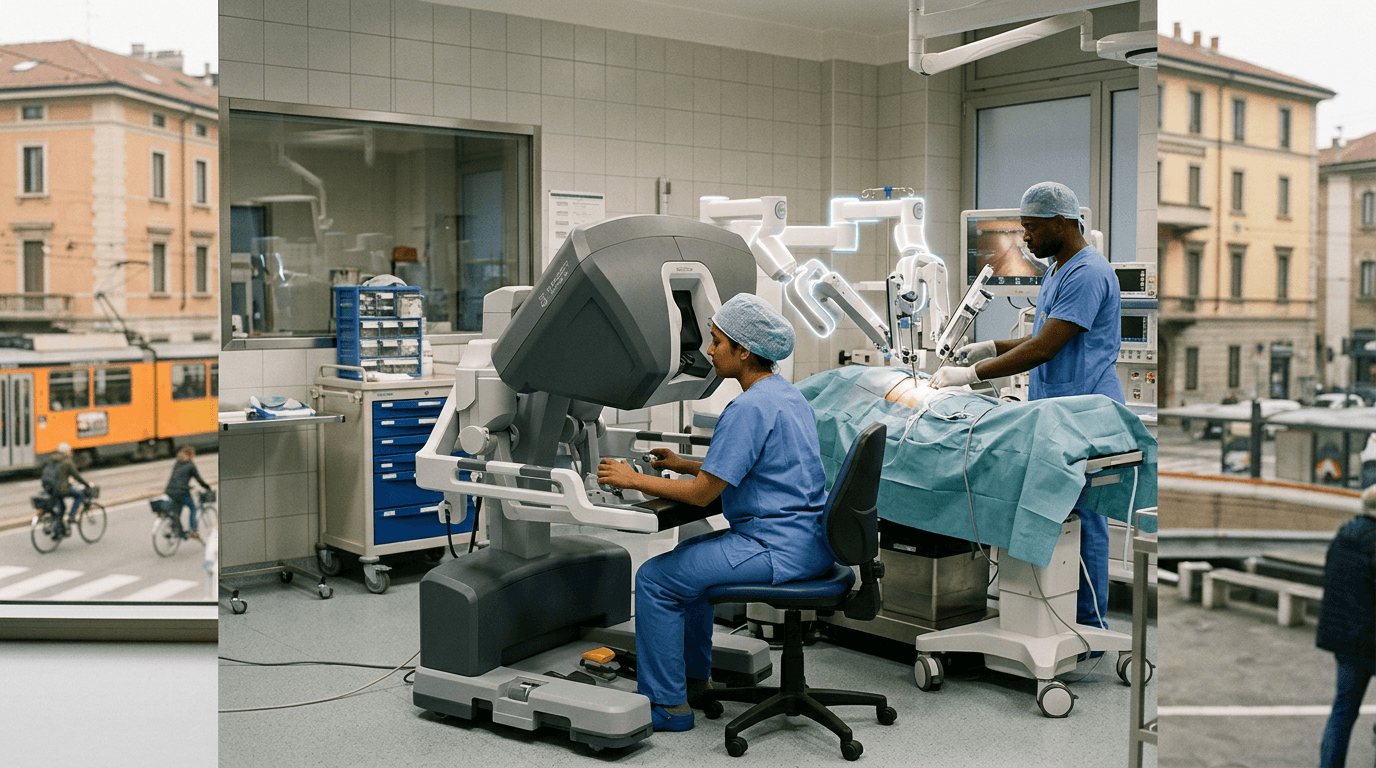
Surgical Robotics Democratization
Geography: Emea · Europe · Europe
Distalmotion (Switzerland, $150M) and Moon Surgical (France, $55M) are building surgical robotic systems that cost a fraction of incumbent platforms like Intuitive Surgical's da Vinci. Distalmotion's Dexter reduces recovery times by 30% and complications by 25%; Moon Surgical's Maestro costs 70% less than competitors while enhancing surgeon performance across minimally invasive procedures.
The cost reduction is the innovation. Robotic surgery has proven benefits — better outcomes, faster recovery, fewer complications — but adoption is limited by the $1-2M price tag of current systems plus expensive per-procedure consumables. European startups are applying hardware cost reduction and software-defined architectures to make surgical robotics accessible to smaller hospitals.
Medical Microinstruments (Italy, $75M) attacks the problem from another angle: microsurgery robots precise enough to reconnect blood vessels thinner than human hair, enabling reconstructive procedures that were previously impossible. European healthcare's universal-access model creates stronger incentives to reduce cost-per-procedure than the US fee-for-service system.
Research this in Signals
Signals turns a topic into a sourced research record you can inspect and rerun. Your first scan is free, and this one starts with Surgical Robotics Democratization already loaded, so edit it or scan as is.