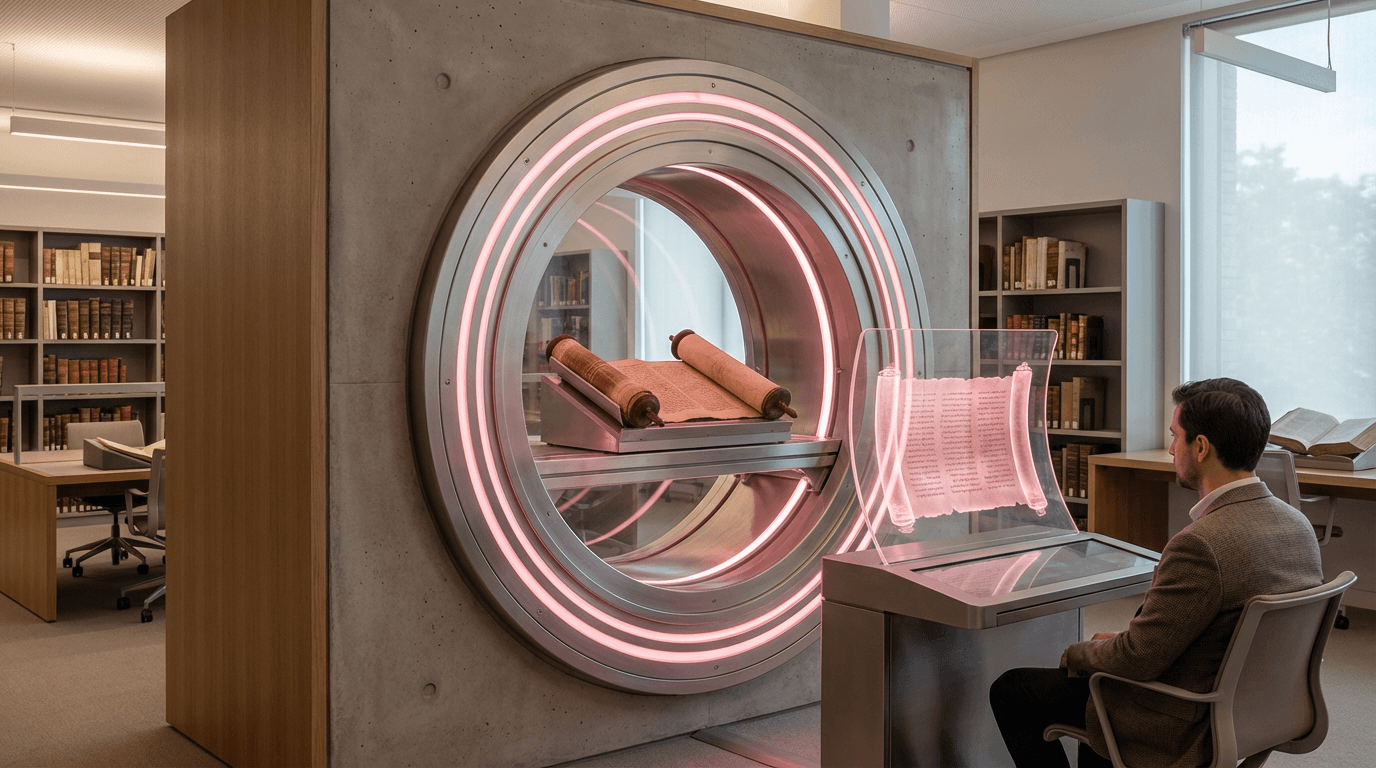
Particle Tomography Scanners
Particle tomography scanners represent a breakthrough in non-invasive imaging technology that enables researchers to read and analyse historical documents that are too fragile, fused, or sealed to be physically opened. These systems employ advanced particle physics techniques, primarily X-ray micro-computed tomography (micro-CT) and muon scattering, to create detailed three-dimensional maps of document interiors. X-ray micro-CT works by rotating an object while bombarding it with X-rays from multiple angles, capturing thousands of cross-sectional images that are then computationally reconstructed into a complete volumetric model. The technology can distinguish between different materials based on their density, allowing it to differentiate ink from papyrus or parchment even when layers are compressed together. Muon tomography, alternatively, uses naturally occurring cosmic ray particles that penetrate deeply through matter, providing complementary data for particularly dense or large objects. Both approaches generate massive datasets that require sophisticated computational algorithms to process, segment individual pages, and flatten the virtual surfaces for legibility.
The preservation and study of historical documents face a fundamental paradox: the most valuable and fragile texts are often the ones we cannot safely examine. Carbonised scrolls from Herculaneum, sealed letters with intact wax seals that reveal historical correspondence practices, water-damaged manuscripts with fused pages, and ancient books whose bindings have become inseparable from their contents all represent knowledge locked away by time and circumstance. Traditional conservation methods risk destroying the very information they seek to preserve, as physically separating fused pages or opening sealed documents can cause irreparable damage. Particle tomography scanners resolve this dilemma by creating a complete digital surrogate of the document's interior structure without requiring any physical intervention. This capability transforms previously inaccessible materials into readable texts, effectively expanding the corpus of available historical sources. The technology also enables new forms of scholarship, allowing researchers to study writing techniques, ink composition, and document construction methods that would be obscured or destroyed by conventional examination.
Research institutions and cultural heritage organisations have begun deploying particle tomography systems to unlock previously unreadable collections. The Vesuvius Challenge, a collaborative research initiative, has successfully used these techniques to reveal text from carbonised Herculaneum papyri that were buried and charred by the eruption of Mount Vesuvius in 79 CE, with machine learning algorithms helping to detect and enhance faint ink traces in the volumetric scans. Similar approaches have been applied to sealed Renaissance letters, medieval manuscripts damaged by fire or water, and Egyptian mummy cartonnage containing recycled papyrus fragments. Beyond ancient materials, the technology shows promise for forensic document analysis, authentication of historical artefacts, and preservation planning for at-risk collections. As scanning resolution improves and computational methods become more sophisticated, particle tomography is establishing itself as an essential tool in digital humanities and cultural heritage preservation, offering a pathway to recover lost voices from the past while ensuring that fragile originals remain physically intact for future generations.
Related Organizations
EduceLab
United States · Research Lab
A digital restoration lab at the University of Kentucky led by Dr. Brent Seales.

A machine learning and computer vision competition to read the Herculaneum Papyri.

Diamond Light Source
United Kingdom · Research Lab
The UK's national synchrotron science facility.
An international research facility in Grenoble, France, operating the most intense X-ray source in the world.
The largest research institute for natural and engineering sciences in Switzerland.

A manufacturer of scientific instruments and superconducting wires (via Bruker EST).

Develops various quantum software tools and compilers within its Advanced Quantum Testbed (AQT) and computer science divisions.

A Baker Hughes business providing industrial inspection solutions, including CT scanners.

A private international research institute dedicated to advancing conservation practice, including environmental management guidelines.

Supporting Evidence
Research this in Signals
Signals turns a topic into a sourced research record you can inspect and rerun. Your first scan is free, and this one starts with Particle Tomography Scanners already loaded, so edit it or scan as is.