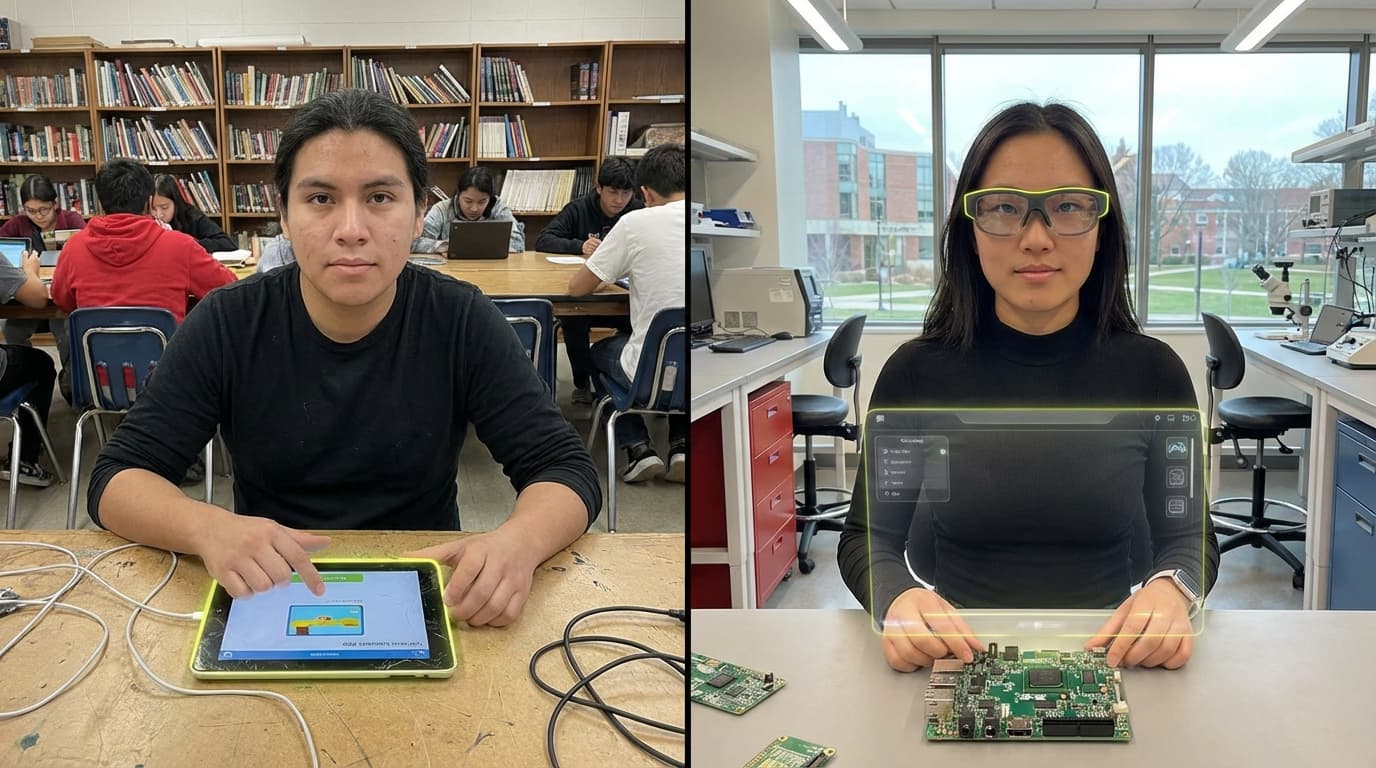
Inequality in Augmented Cognition
The inequality in augmented cognition framework examines the risks and implications of access gaps between students who have access to cognitive-sensing devices, AI tutoring resources, and other cognitive augmentation technologies and those who do not, focusing on the potential for these technologies to create or exacerbate educational stratification. As cognitive-sensing devices, AI tutors, and other augmentation technologies become available, there's a risk that unequal access could create two-tier educational systems where students with access to augmentation technologies have significant advantages over those without, potentially widening achievement gaps and creating new forms of educational inequality. This research focuses on understanding these risks, developing strategies to ensure equitable access, and addressing the broader social implications of cognitive augmentation technologies in education.
This framework addresses fundamental questions about equity and access as educational technologies become more powerful and potentially transformative, where unequal access to augmentation technologies could create new forms of educational inequality. By examining these risks and developing strategies for equitable access, these frameworks can help prevent educational technologies from exacerbating inequality. Researchers, policy makers, educational institutions, and equity advocates are exploring these issues, with growing recognition of the need to address access gaps.
The framework is particularly significant as cognitive augmentation technologies become more available and effective, where ensuring equitable access could prevent these technologies from creating new forms of educational stratification. As these technologies advance, developing strategies for equitable access could become essential. However, ensuring affordable access, managing the costs of technology, creating sustainable models for equitable distribution, and addressing broader social inequalities remain challenges. The framework represents an important area of equity research, but requires ongoing attention and policy development to be effective.
Related Organizations
OECD
France · Government Agency
Adopted the 'Recommendation on Responsible Innovation in Neurotechnology' to guide governments and companies.

Produces 'Ethically Aligned Design' standards, addressing the legal and ethical implications of autonomous systems.

Develops BCI-enabled headphones that detect focus and intent to control digital experiences.

Creates open-source brain-computer interface tools and the Galea headset (integrating with VR) for researching physiological responses.

Produces EEG headsets and the BCI-OS platform, allowing developers to build applications that respond to cognitive stress and facial expressions.

Creators of the Muse headband, a consumer EEG device used for meditation and cognitive research.

Neuroscience company developing non-invasive brain recording technology (Flow and Flux).

A UNICEF and ITU initiative to connect every school to the internet.
Supporting Evidence
Research this in Signals
Signals turns a topic into a sourced research record you can inspect and rerun. Your first scan is free, and this one starts with Inequality in Augmented Cognition already loaded, so edit it or scan as is.