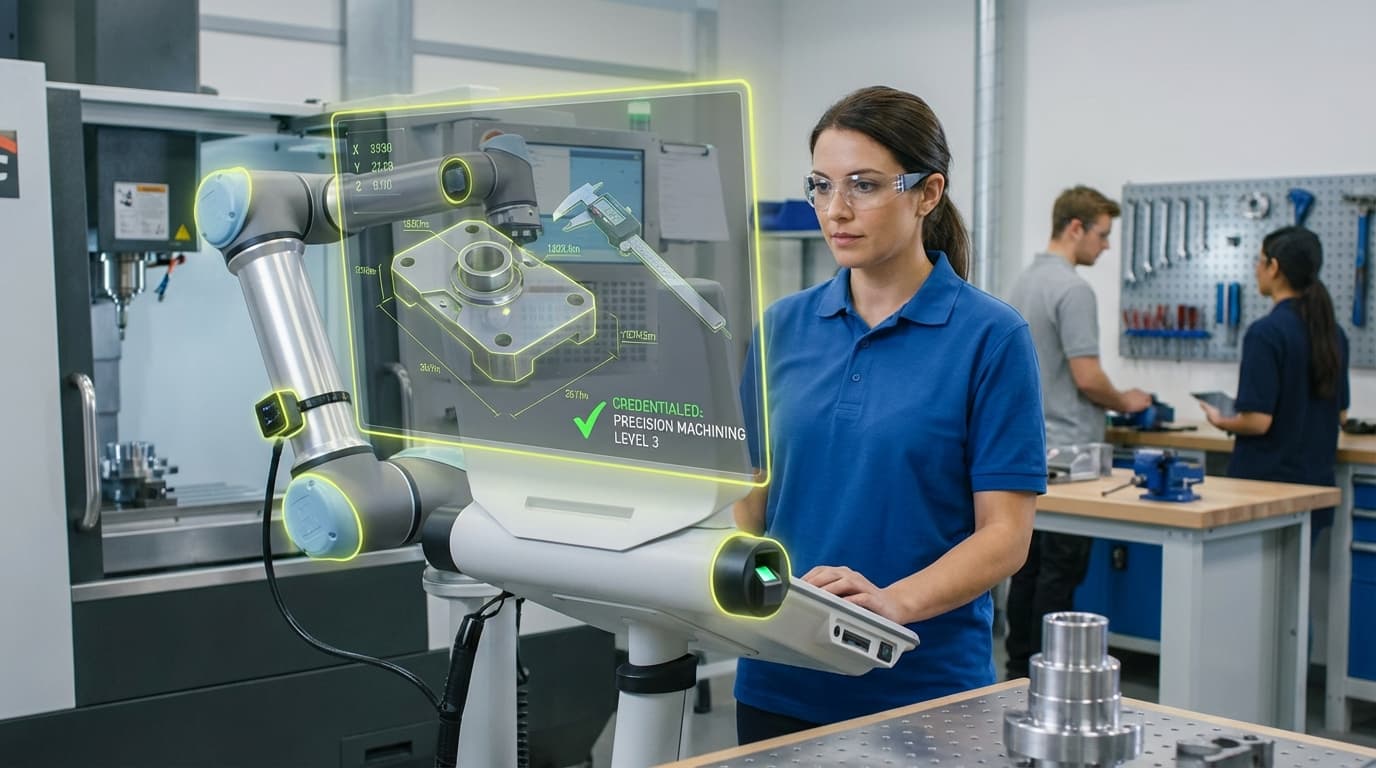
Credentialing & Verification
Credentialing and verification frameworks establish standards, validation processes, and interoperability protocols for verifying skills and competencies acquired through synthetic training environments, simulations, virtual labs, and other non-traditional learning paths. As learning increasingly occurs in simulated environments—from VR surgical training to virtual coding environments—these frameworks address how to validate that skills demonstrated in synthetic contexts transfer to real-world performance, ensuring that credentials accurately represent actual capabilities. The frameworks also cover interoperability and transparency around micro-credentials, digital badges, and other granular credentials, establishing standards for how these credentials are issued, verified, and recognized across different institutions, employers, and platforms, enabling portable, verifiable recognition of skills from diverse learning experiences.
This framework addresses the challenge of recognizing and validating skills acquired through increasingly diverse and non-traditional learning pathways, where traditional credentialing systems may not adequately capture competencies developed through simulations, online learning, or informal experiences. By establishing standards for verification and interoperability, these frameworks can enable more flexible, portable credentialing that recognizes diverse learning paths. Credentialing organizations, educational institutions, employers, and standards bodies are exploring these issues, with growing efforts to create interoperable credentialing systems.
The framework is particularly significant as learning becomes more diverse and credentialing needs to recognize skills from various sources, where establishing verification standards could enable more flexible and accurate credentialing. As synthetic training becomes more common, ensuring that credentials accurately represent real-world capabilities could become essential. However, establishing verification standards, ensuring transfer validity, creating interoperability, and gaining widespread adoption remain challenges. The framework represents an important evolution in credentialing, but requires continued development and industry adoption to be effective.
Related Organizations
The world's leading non-profit collaborative for edtech interoperability (formerly IMS Global).

A global leader in simulation and training for civil aviation, defense, and healthcare.


A surgical training and assessment platform using VR to allow surgeons to practice procedures.

Platform for issuing digital certificates and open badges.

Provides virtual laboratory simulations for science education and training.
The international standards organization for the Web, responsible for the Decentralized Identifiers (DID) and Verifiable Credentials (VC) recommendations.

Trade association issuing professional IT certifications, increasingly utilizing performance-based questions (simulations).

Enterprise content services provider that acquired Learning Machine and now offers blockchain-based credentialing solutions.
Home of the Affective Computing research group led by Rosalind Picard.

A major cloud-based people development software provider (LMS/LXP/HR).
Supporting Evidence
Research this in Signals
Signals turns a topic into a sourced research record you can inspect and rerun. Your first scan is free, and this one starts with Credentialing & Verification already loaded, so edit it or scan as is.