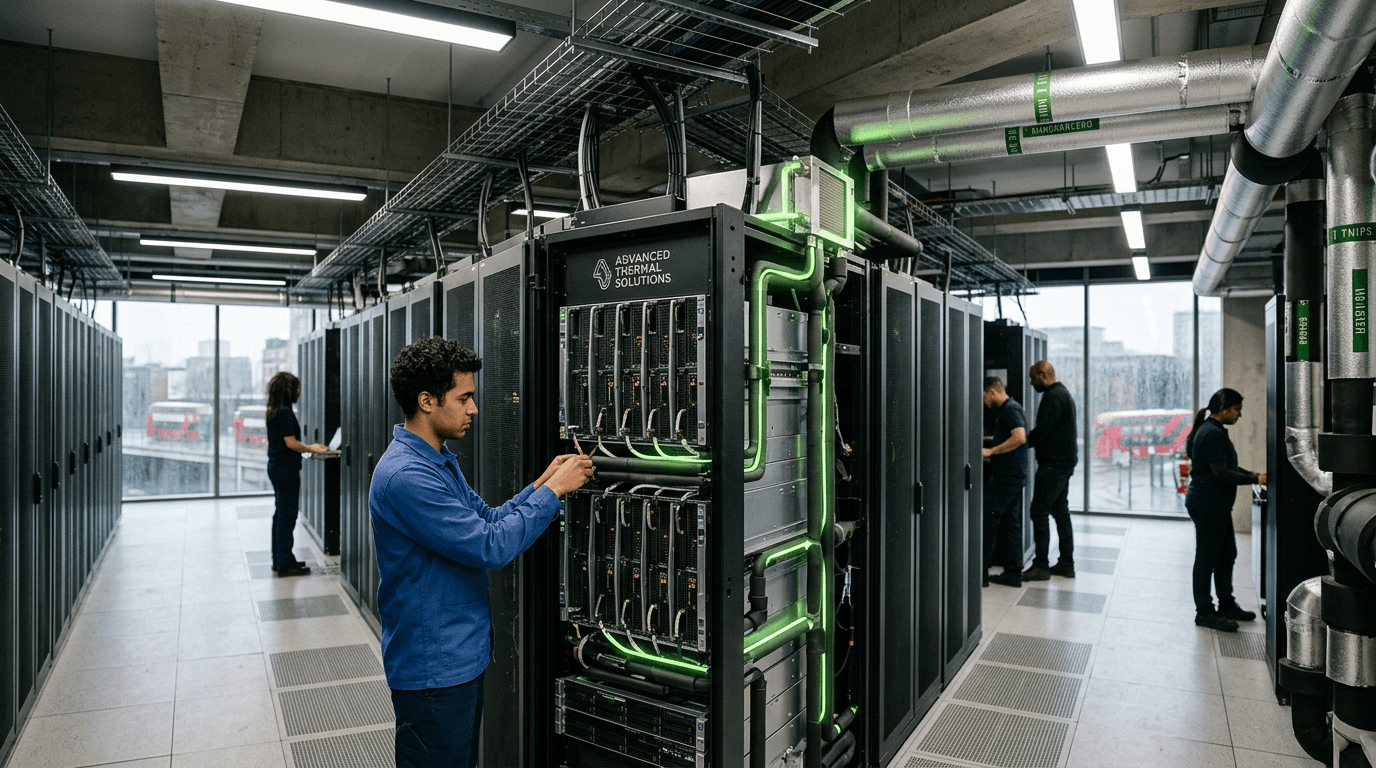
Advanced Thermal Management
Advanced thermal management encompasses technologies that control temperature, move heat, or convert waste heat into useful work. In data centres, liquid cooling, immersion cooling, and heat reuse (e.g. for district heating) reduce reliance on energy-intensive air conditioning and improve power usage effectiveness. In electric vehicles, thermal systems manage battery temperature for performance and longevity and integrate cabin heating and cooling with powertrain efficiency. In electronics, heat spreaders, vapour chambers, and phase-change materials help high-power chips operate within safe limits. Industrial heat recovery captures waste heat from processes and converts it to power or useful heat elsewhere.
The technology addresses the fact that a large share of primary energy is rejected as waste heat; recovering or repurposing it improves overall efficiency and can reduce carbon footprint. In addition, many modern systems—from chips to batteries—are thermally limited; better thermal management allows higher power density, longer life, or smaller form factors. As electrification and compute demand grow, thermal design is increasingly a bottleneck and an opportunity for innovation.
Research and deployment are advancing in materials (e.g. high-thermal-conductivity substrates), system integration, and control algorithms. Standards and best practices for data centre heat reuse and EV thermal systems are evolving. Advanced thermal management will remain critical for the performance, reliability, and sustainability of energy-intensive and power-dense applications.
Research this in Signals
Signals turns a topic into a sourced research record you can inspect and rerun. Your first scan is free, and this one starts with Advanced Thermal Management already loaded, so edit it or scan as is.