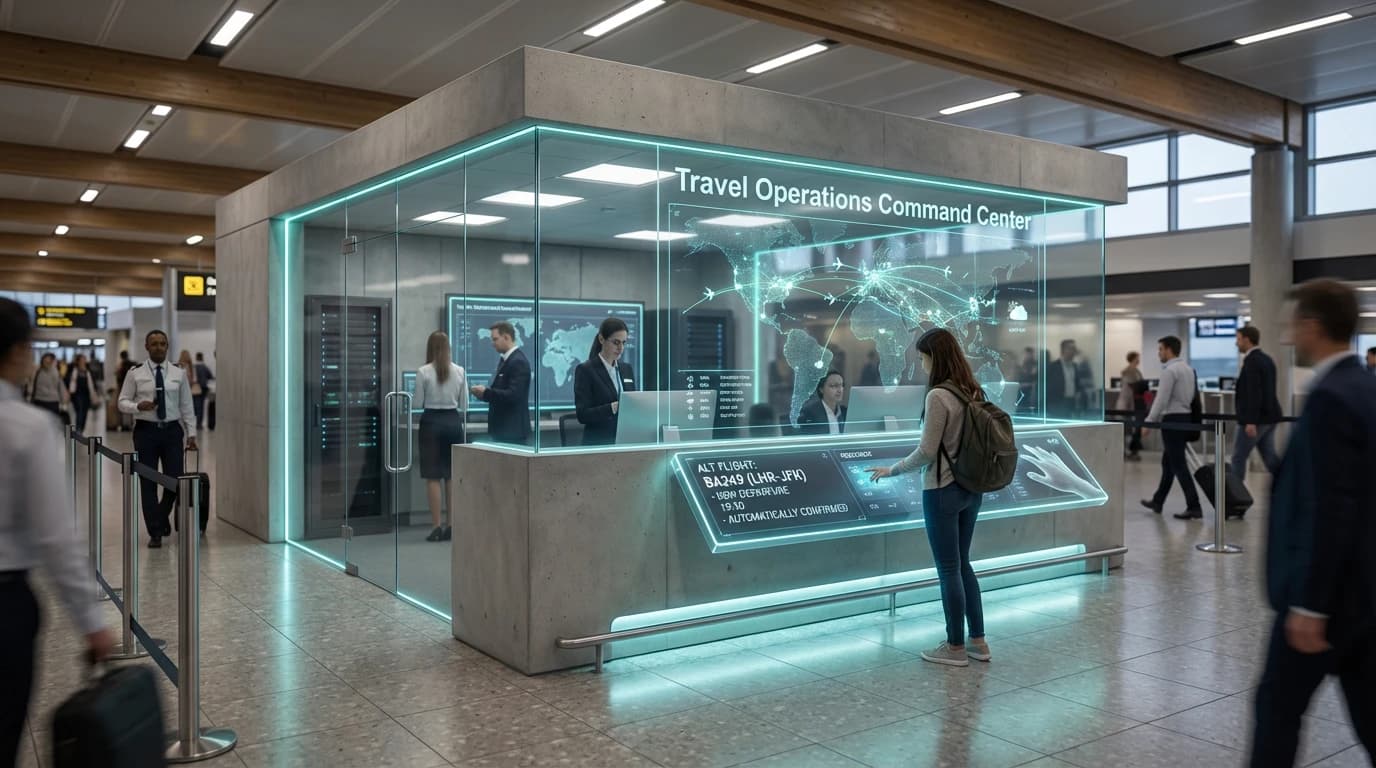
Disruption Prediction & Auto-Rebooking
Travel disruptions—whether caused by weather events, mechanical failures, or cascading delays across interconnected networks—represent one of the most persistent pain points in modern mobility. Traditional reactive approaches to rebooking leave passengers stranded at gates or stations, forcing them to navigate complex customer service queues while optimal alternative routes disappear. The fundamental challenge lies in the sheer complexity of predicting disruptions across multiple transportation modes and carriers, each operating with different data systems, schedules, and inventory management protocols. Disruption prediction and auto-rebooking systems address this challenge by deploying machine learning models that continuously analyse vast streams of real-time data—including weather patterns, historical delay records, aircraft positioning, crew availability, air traffic control communications, and even social media signals—to forecast potential disruptions hours or even days before they occur. These predictive models identify cascading effects that human operators might miss, such as how a morning delay in one hub city could trigger afternoon cancellations across an entire network.
The transformative potential of these systems extends beyond mere prediction to autonomous action. When a disruption is forecasted with sufficient confidence, the technology can automatically search across multiple carriers, transportation modes, and routing options to identify viable alternatives that match the traveller's original itinerary constraints. Advanced implementations can execute rebooking without human intervention, seamlessly transferring passengers from a delayed flight to an alternative routing that might combine rail and air travel, or rerouting through different connection points entirely. This capability is particularly valuable for complex multi-leg journeys where manual rebooking would require coordinating across multiple carriers with limited interline agreements. The system also optimises for passenger preferences and constraints—such as avoiding overnight layovers, maintaining seat class, or ensuring connections for checked baggage—while simultaneously managing inventory across partner networks to prevent overbooking scenarios.
Early deployments of disruption prediction systems have emerged primarily within major airline alliances and integrated rail networks, where data sharing agreements enable the cross-carrier coordination necessary for effective rebooking. Industry analysts note that the technology's effectiveness increases substantially when transportation providers share operational data in real-time, creating network effects that benefit all participants. Some implementations now extend beyond simple rebooking to proactive passenger communication, sending personalised notifications with alternative options before travellers even arrive at the airport or station. The integration of these systems with mobile applications and digital wallets enables frictionless execution, automatically updating boarding passes and travel documents without requiring passenger intervention. As climate volatility increases the frequency and unpredictability of weather-related disruptions, and as travellers increasingly expect seamless door-to-door journeys across multiple modes, disruption prediction and auto-rebooking represents a critical evolution in travel technology. The trajectory points toward fully autonomous travel management systems that treat disruptions not as exceptions requiring human intervention, but as predictable variables to be optimised around, fundamentally reshaping passenger expectations for reliability and service recovery in modern mobility networks.
Related Organizations

Provides predictive flight delay algorithms using machine learning.

Hopper
Canada · Company
Travel fintech company offering price prediction and disruption protection products.


Aviation analytics company providing data and analytics to the travel industry.

Digital aviation company and operator of the world's largest flight tracking platform.

Travel booking portal for Capital One cardholders.

Creators of CausalImpact, a package for causal inference using Bayesian structural time-series.

Provides a platform for airlines to optimize capacity and revenue.

Travel technology provider offering ERP and booking engines.

A major US airline that has signed a commercial agreement to purchase Boom Supersonic aircraft.
Supporting Evidence
Research this in Signals
Signals turns a topic into a sourced research record you can inspect and rerun. Your first scan is free, and this one starts with Disruption Prediction & Auto-Rebooking already loaded, so edit it or scan as is.