Ground Segment Automation Platforms
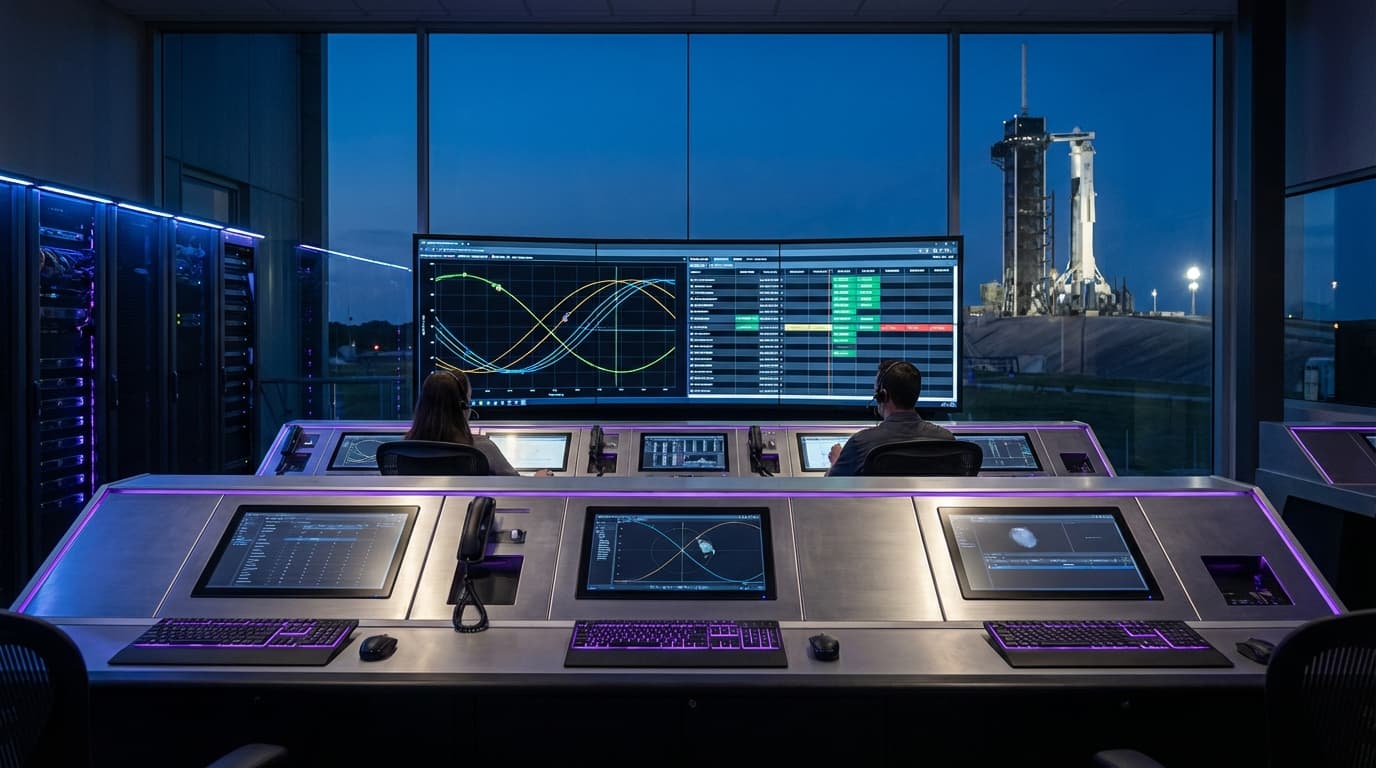
Ground segment automation platforms are software systems that automatically manage the operations of satellite constellations, including scheduling ground station passes, allocating communication bandwidth, routing data through relay satellites, and triaging anomalies across large fleets. These platforms use AI and automation to handle routine operations that would be impossible to manage manually for mega-constellations with thousands of satellites, enabling small human teams to operate large fleets effectively.
This innovation addresses the operational complexity of large satellite constellations, where manually managing thousands of satellites would require enormous teams and be prone to errors. By automating routine operations, these platforms enable efficient operation of large fleets, reduce operational costs, and improve reliability. The technology is essential for mega-constellations like Starlink, where manual operations would be impractical. Companies operating large constellations are developing and deploying these systems.
The technology is becoming essential infrastructure for large satellite constellations, where automation is the only practical way to manage operations at scale. As constellations grow to thousands or tens of thousands of satellites, automation becomes critical for operational viability. However, the technology faces challenges including ensuring reliability, handling edge cases, and maintaining appropriate human oversight. The technology represents an important evolution in space operations, enabling new business models and capabilities that wouldn't be possible with manual operations. Success depends on developing robust, reliable automation systems that can handle the complexity of large-scale space operations while maintaining safety and allowing human intervention when needed.
Related Organizations

A technology company specializing in directed-energy weapons, unmanned systems, and satellite communications.

Provides a cloud-native platform with APIs to build bespoke ground segment software and automate mission operations.

Operates the Freedom Platform, a software solution that automates pass scheduling and antenna management across a global network.

Develops StellarStation, a cloud-based platform that virtualizes ground station sharing and automates pass scheduling.

Provides Ground Segment as a Service (GSaaS) with automated scheduling and operations via their Leaf Line and Leaf Key services.

Cloud computing giant offering Amazon Braket.

Through Copilot and the 'Recall' feature in Windows, Microsoft is integrating persistent memory and agentic capabilities directly into the operating system.
Offers a global ground station network with an automated platform for real-time scheduling and data delivery.

Owner of Major Tom, a mission operations platform that unifies ground station scheduling and telemetry monitoring.

Develops the Hifly satellite control system and other ground segment automation software for major institutional and commercial missions.

Develops OrbitX, a next-generation satellite operations and ground control software suite.

Operates the BioFabrication Facility (BFF) on the ISS for printing human tissue.
Supporting Evidence
Research this in Signals
Signals turns a topic into a sourced research record you can inspect and rerun. Your first scan is free, and this one starts with Ground Segment Automation Platforms already loaded, so edit it or scan as is.