Digital Twin Spacecraft
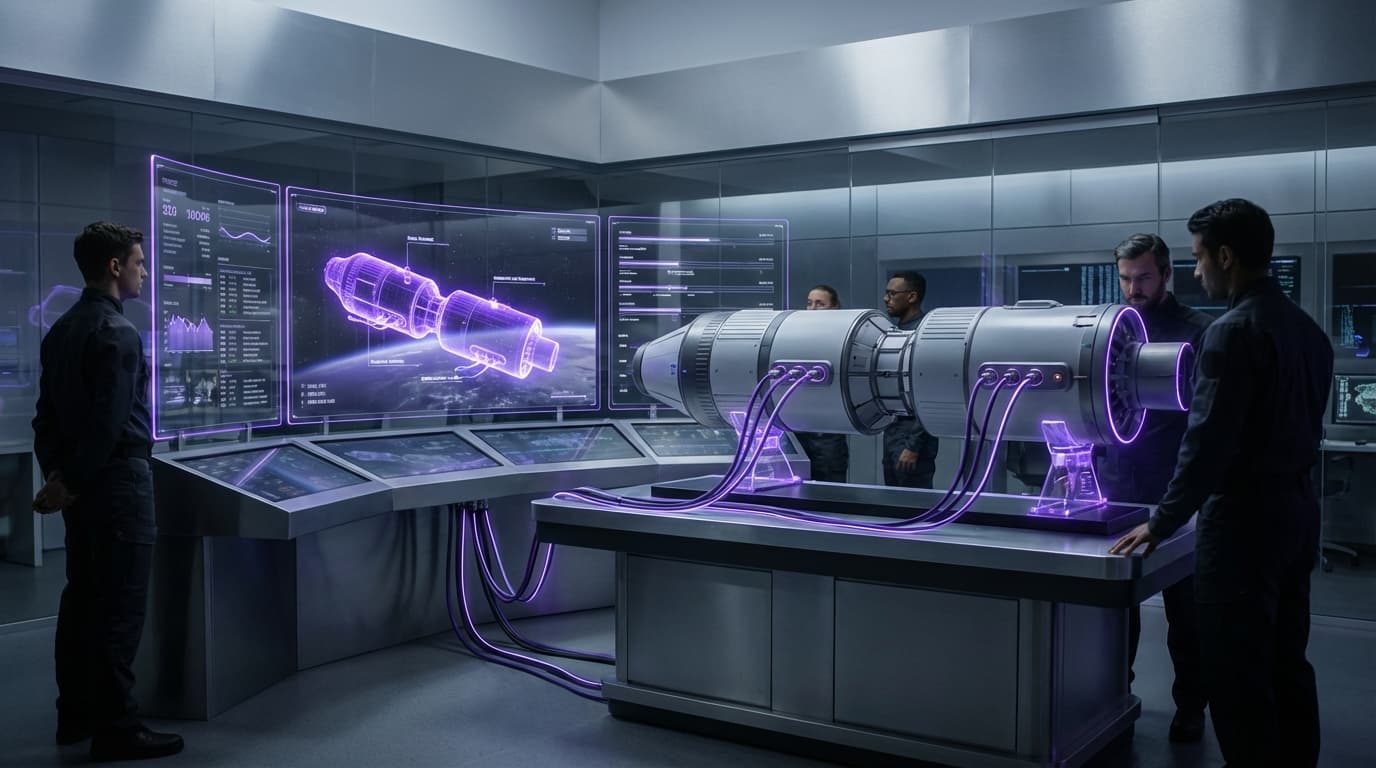
Digital twin spacecraft are high-fidelity virtual replicas that continuously synchronize with real spacecraft through telemetry, creating accurate models that mirror the actual vehicle's state, health, and behavior. These systems enable engineers to rehearse maneuvers, diagnose anomalies, test software updates, and validate procedures in a risk-free virtual environment before implementing them on the actual spacecraft, dramatically reducing mission risk.
This innovation addresses the challenge of operating complex spacecraft where mistakes can be catastrophic and opportunities to test are limited. By maintaining accurate digital twins, mission teams can understand spacecraft behavior, predict issues, and validate solutions before implementing them. The technology is being adopted across the space industry, with digital twins becoming standard tools for mission operations and vehicle development.
The technology is particularly valuable for complex missions where understanding vehicle behavior is critical and for new vehicle development where digital twins can accelerate certification and reduce risk. As spacecraft become more complex and autonomous, digital twins provide essential tools for understanding, testing, and operating them safely. The technology enables more confident operations, faster problem resolution, and better mission outcomes. However, maintaining accurate digital twins requires significant effort to keep models synchronized with actual vehicle behavior, and model accuracy is critical for the technology to be effective.
Related Organizations

Offers a software platform for satellites that includes 'TrueTwin' simulation and onboard autonomy for flight operations.

Offers the Xcelerator portfolio, enabling comprehensive digital twins for spacecraft design, manufacturing, and operations.

Builds space simulation and analytics platforms for training and mission planning.

Software corporation specializing in 3D design and digital mock-ups.
Developer of MATLAB and Simulink, the foundational tools for Model-Based Design and control system digital twins.

A company building autonomous orbital vehicles for space security and defense.


Provides Hardware-in-the-Loop (HIL) testing systems that connect physical electronics to digital twin simulations.

Uses a constellation of nanosatellites to collect radio occultation data, fed into ML models for forecasting.
Supporting Evidence
Research this in Signals
Signals turns a topic into a sourced research record you can inspect and rerun. Your first scan is free, and this one starts with Digital Twin Spacecraft already loaded, so edit it or scan as is.