XR Immersive Flight Training & Synthetic Environments
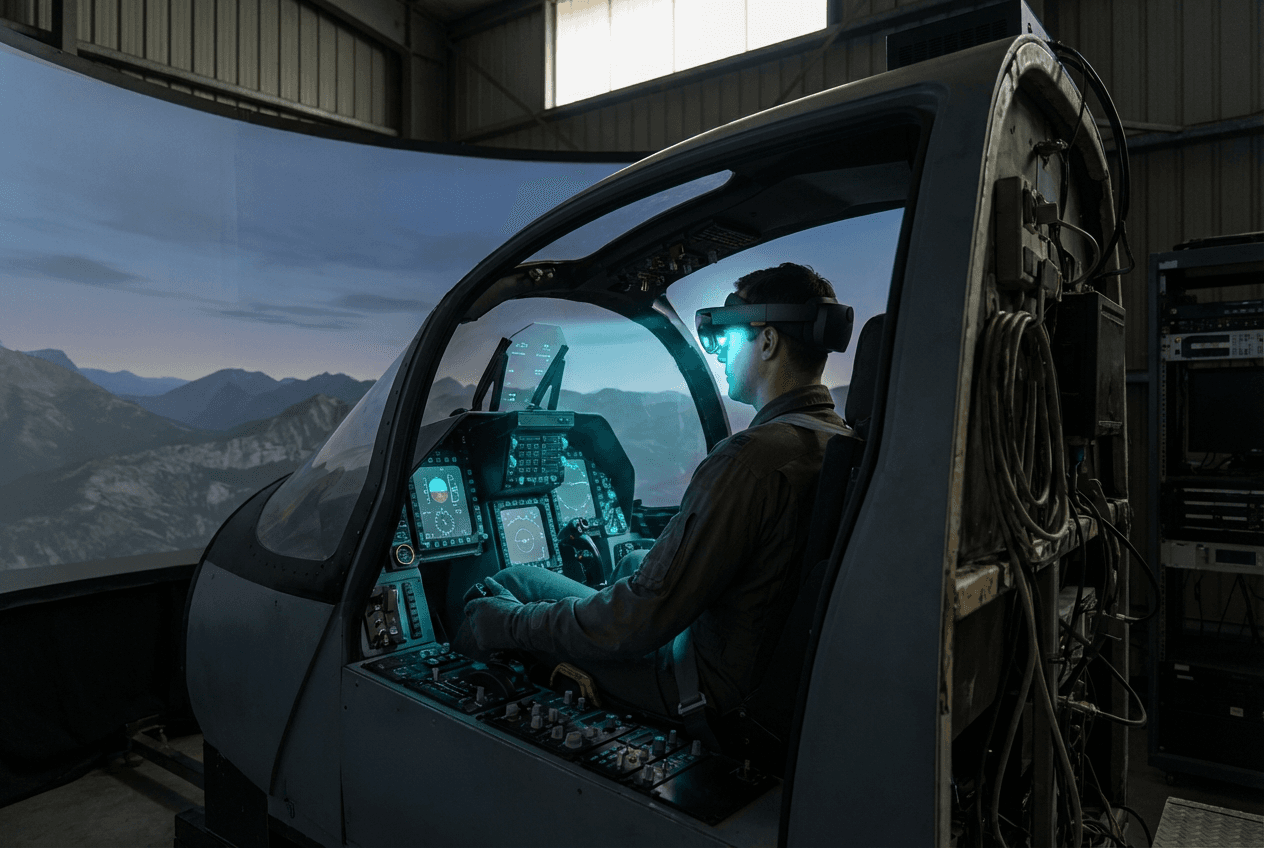
Extended reality (XR) training systems represent a convergence of virtual reality (VR), augmented reality (AR), and mixed reality (MR) technologies designed to replicate the complex sensory and cognitive demands of aviation operations without requiring physical aircraft or traditional full-motion simulators. These systems employ high-resolution head-mounted displays, spatial audio engines, and hand-tracking controllers to create immersive cockpit environments that respond to pilot inputs in real time. Advanced implementations incorporate haptic gloves that simulate control surface resistance, eye-tracking cameras that monitor scan patterns and attention allocation, and photogrammetry-derived terrain databases that reproduce actual airfields and approach corridors with centimeter-level accuracy. The underlying architecture typically combines game engine technology with certified aerodynamic models, allowing trainees to experience realistic aircraft behavior across normal and non-normal flight regimes while instructors monitor performance metrics and physiological indicators such as pupil dilation and head movement patterns that correlate with workload and situational awareness.
The aviation industry faces persistent challenges in training capacity, cost, and accessibility that XR systems directly address. Traditional flight simulators require dedicated facilities, significant capital investment, and scheduling coordination that limits training throughput, particularly for airlines expanding fleets or introducing new aircraft types. XR platforms enable distributed training where pilots can rehearse procedures in hotel rooms during layovers, practice emergency scenarios without tying up expensive simulator slots, and conduct collaborative multi-crew exercises with colleagues located on different continents. For maintenance technicians, AR overlays can project wiring diagrams and torque specifications directly onto engine components, reducing errors and training time. The technology also enables training scenarios that would be impractical or unsafe in physical simulators, such as catastrophic system failures, extreme weather encounters, or security incidents, allowing crews to build muscle memory and decision-making skills for rare but critical events. Airlines report that XR pre-training can reduce the number of full-motion simulator sessions required for type rating transitions, potentially cutting training costs by thirty to forty percent while improving initial proficiency.
Several major carriers and training organizations have deployed XR systems for procedural training, spatial disorientation familiarization, and cabin crew emergency drills, with early results indicating improved knowledge retention and transfer of skills to actual flight operations. Military aviation has embraced the technology for mission rehearsal, allowing pilots to virtually fly over actual target areas using satellite imagery before deployment. However, the path to widespread adoption hinges on regulatory bodies establishing clear standards for XR training credit toward certification requirements. Aviation authorities are developing frameworks that define acceptable fidelity levels, instructor qualification standards, and the specific maneuvers or procedures that can be credited when performed in synthetic environments rather than physical simulators or aircraft. As computational power increases and display resolution improves, the line between physical and synthetic training continues to blur, suggesting a future where pilots may complete significant portions of initial and recurrent training without entering a traditional simulator, fundamentally reshaping the economics and accessibility of aviation training while maintaining the rigorous safety standards the industry demands.
Related Organizations

Develops and operates the first and only VR flight simulation training device (FSTD) qualified by EASA, specializing in helicopter training.
Develops the Advanced Tactical Augmented Reality System (ATARS), allowing pilots to dogfight against virtual adversaries in real jets.

Regulatory body defining the 'U-space' regulatory framework for drone integration in Europe.

Manufacturer of 'bionic display' headsets that use a high-density focus display inside a peripheral context display.

Develops the XTAL VR headset and portable flight simulators for professional pilot training, used extensively by air forces.

Developers of VBS (Virtual Battlespace), a game-engine-based simulation platform used by militaries worldwide.

A global leader in simulation and training for civil aviation, defense, and healthcare.

Integrates XR pilot training rigs and software for the US Air Force's Pilot Training Next program.

Supplier of real-time image generators and geo-specific databases for flight simulators and XR applications.

Supporting Evidence
Research this in Signals
Signals turns a topic into a sourced research record you can inspect and rerun. Your first scan is free, and this one starts with XR Immersive Flight Training & Synthetic Environments already loaded, so edit it or scan as is.