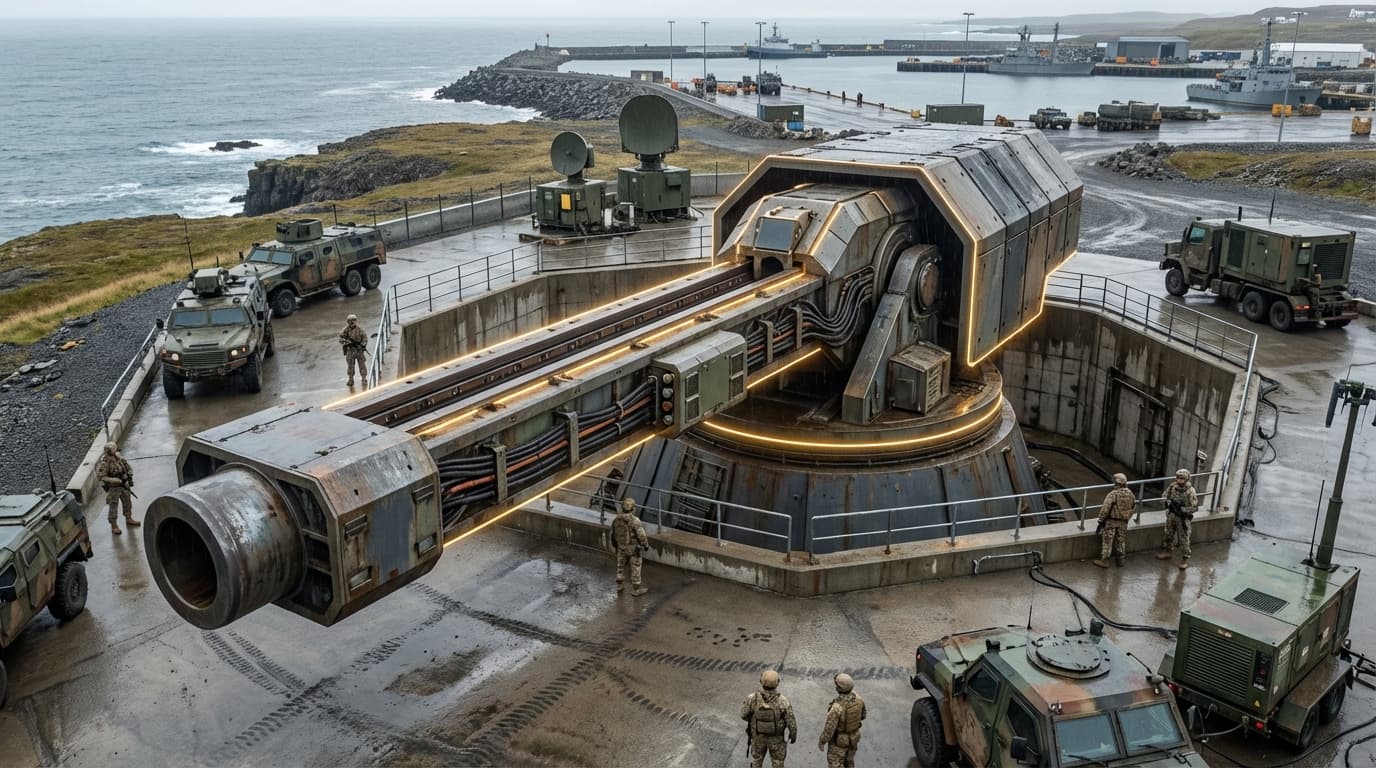
Railgun Artillery
Railgun artillery represents a revolutionary departure from conventional gunpowder-based weapons systems, utilizing electromagnetic force to propel projectiles at velocities exceeding Mach 6. The fundamental mechanism involves passing a massive electrical current through parallel conductive rails, creating an intense magnetic field that accelerates a conductive projectile or armature along the rails. This electromagnetic acceleration eliminates the need for chemical propellants entirely, instead relying on stored electrical energy discharged in milliseconds to achieve hypersonic velocities. The absence of explosive propellants not only simplifies logistics and reduces hazardous material handling but also enables substantially higher muzzle velocities than achievable through conventional artillery. Current prototypes typically employ pulsed power systems capable of delivering tens of megajoules of energy per shot, with advanced capacitor banks and switching systems managing the extreme electrical demands of each launch sequence.
The strategic implications of railgun technology address several critical limitations inherent in modern naval and land-based artillery systems. Conventional naval guns face range constraints typically limited to 20-30 kilometers, while guided missiles, though longer-ranged, carry significant per-round costs often exceeding hundreds of thousands of dollars. Railgun projectiles, traveling at hypersonic speeds with kinetic energy alone, can potentially engage targets at ranges exceeding 200 kilometers while maintaining costs per round measured in tens of thousands of dollars rather than the prohibitive expense of precision-guided munitions. This economic advantage becomes particularly compelling in missile defense scenarios, where the ability to fire multiple low-cost interceptors against incoming threats fundamentally alters the cost-exchange ratio that currently favors offensive systems. Additionally, the extreme velocities achieved reduce time-to-target dramatically, limiting adversary reaction windows and enhancing effectiveness against time-sensitive or mobile targets. The technology also promises simplified logistics chains, as electromagnetic projectiles require no propellant magazines or the extensive safety protocols associated with storing conventional ammunition.
Naval research programs have demonstrated functional railgun prototypes aboard test vessels, with successful firings validating core technical principles while revealing significant engineering challenges. The primary obstacles center on barrel erosion from the extreme electromagnetic and thermal stresses of repeated firings, power generation and storage requirements that strain existing shipboard electrical systems, and the development of projectiles capable of surviving the intense acceleration forces while maintaining accuracy over extended ranges. Land-based applications face similar technical hurdles but benefit from fewer space and weight constraints, potentially enabling larger power systems and more robust cooling infrastructure. Industry analysts note that practical deployment likely requires advances in materials science for rail durability, compact high-density energy storage, and sophisticated guidance systems for projectiles that must maintain trajectory through hypersonic flight regimes. As naval forces worldwide pursue distributed lethality concepts and seek asymmetric advantages against increasingly sophisticated missile threats, railgun technology represents a potential paradigm shift in long-range precision fires, though the timeline for operational systems remains dependent on resolving fundamental engineering challenges around power management, barrel longevity, and projectile guidance at hypersonic velocities.
Related Organizations
Acquisition, Technology & Logistics Agency (ATLA)
Japan · Government Agency
An agency of the Japanese Ministry of Defense responsible for defense equipment.

A division of General Atomics focusing on high-power electromagnetics.

A binational research institute for defense and security.

A premier research and development center for the US Navy.

Defense and aerospace company known for the ADAPTIV thermal camouflage system.
China Aerospace Science and Industry Corporation (CASIC)
China · Government Agency
A state-owned enterprise that designs, develops, and manufactures a range of spacecraft, launch vehicles, and defense systems.
IAP Research
United States · Company
Specializes in electromagnetic launch and pulsed power technologies.
Supporting Evidence
Research this in Signals
Signals turns a topic into a sourced research record you can inspect and rerun. Your first scan is free, and this one starts with Railgun Artillery already loaded, so edit it or scan as is.