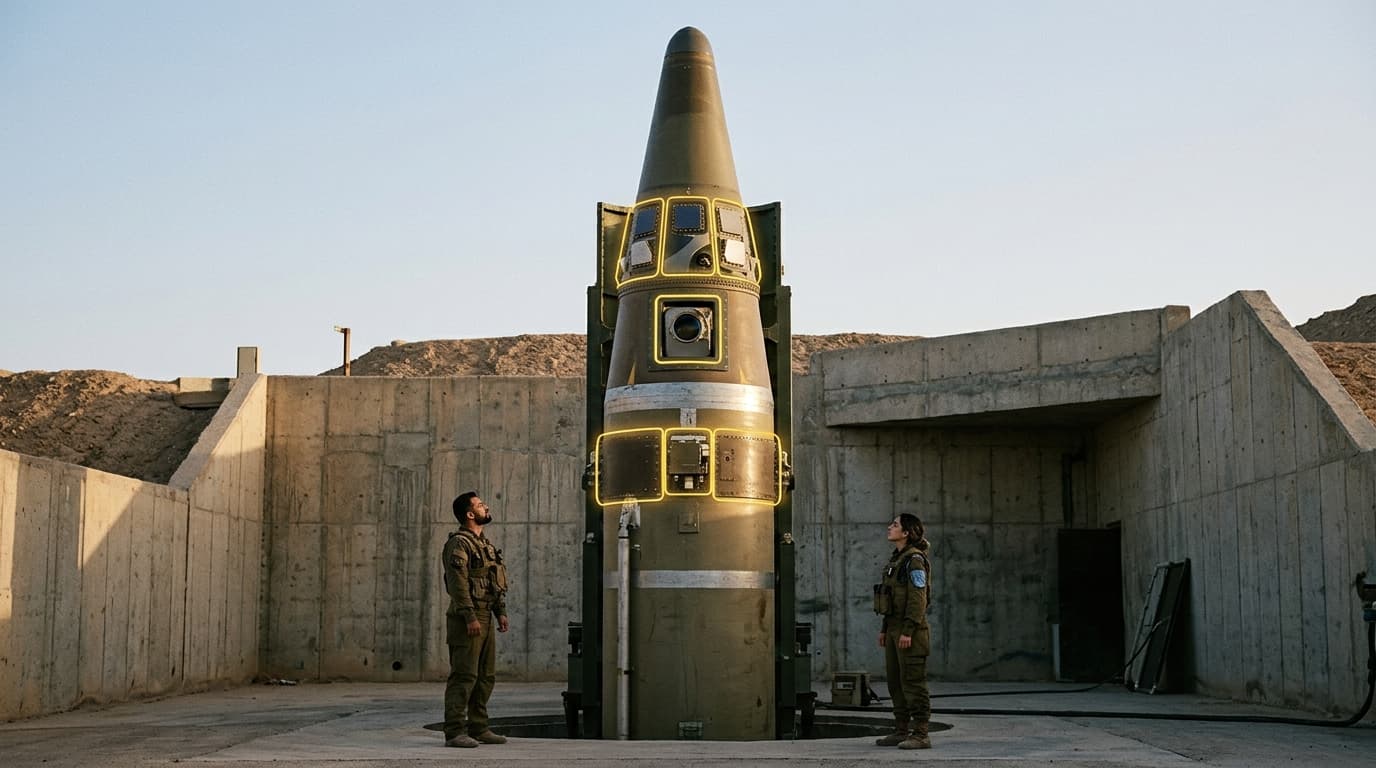
Precision-Guided Ballistic Missile Systems
Geography: Emea · Middle East · Iran
Iran maintains the largest and most diverse ballistic missile arsenal in the Middle East, with systems spanning short-range tactical weapons to medium-range ballistic missiles (MRBMs) capable of reaching targets across the region. Key systems include the solid-fuel Sejjil-2 (2,000+ km range), the Emad (1,700 km, first Iranian missile with a guided reentry vehicle), and the Kheibar Shekan (1,450 km with improved accuracy). The shift from liquid to solid fuel across the inventory improves readiness and survivability.
The critical technological advancement in recent years has been the addition of terminal guidance to conventionally-armed ballistic missiles. Early Iranian missiles had circular error probable (CEP) measurements in kilometers; newer systems claim CEP figures in the tens of meters, achieved through GPS/INS integration, scene-matching terminal guidance, and maneuverable reentry vehicles. The April and October 2024 strikes against Israel provided the first large-scale combat data on these systems' actual accuracy.
Iran's missile program is the cornerstone of its deterrence strategy, compensating for a conventional military that cannot match regional adversaries in airpower or naval capability. The program has continued to advance despite decades of sanctions and technology denial, demonstrating deep indigenous engineering capability in propulsion, guidance, materials science, and systems integration. It also represents a proliferation concern, with technology and components shared with allied groups in the region.
Research this in Signals
Signals turns a topic into a sourced research record you can inspect and rerun. Your first scan is free, and this one starts with Precision-Guided Ballistic Missile Systems already loaded, so edit it or scan as is.