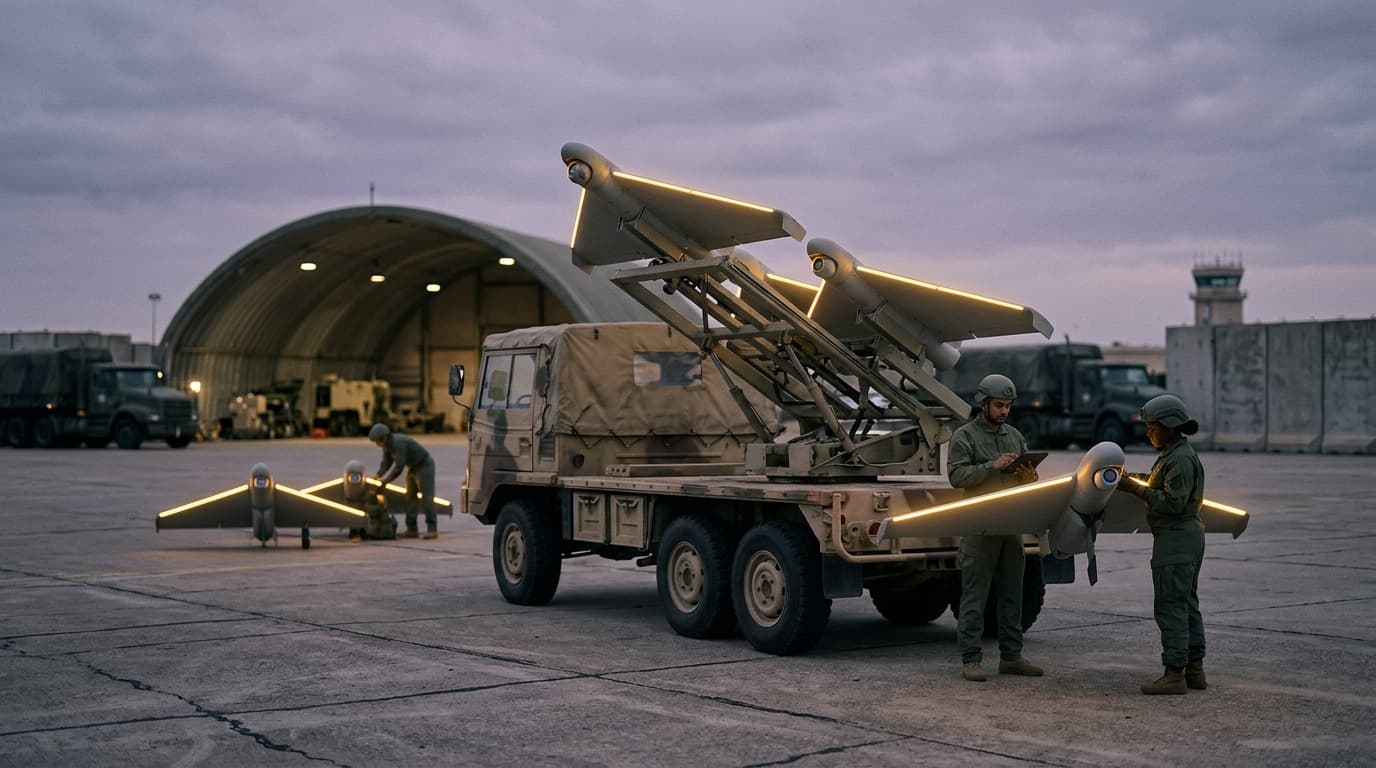
Loitering Munition / Kamikaze Drone Systems
Geography: Emea · Middle East · Iran
Iran's Shahed family of loitering munitions — particularly the Shahed-136 and its variants — represents a mature class of low-cost, mass-producible one-way attack drones. The Shahed-136 uses a small turbojet engine, GPS/INS guidance, and a fragmentation warhead, with a range of approximately 2,000 km. Unit costs are estimated at $20,000-50,000, a fraction of the air defense missiles required to intercept them. Russia has produced localized variants (Geran-2) under technology transfer arrangements.
The strategic significance of these systems lies not in their individual sophistication but in their cost-exchange ratio and scalability. When launched in salvos, they saturate air defenses by forcing defenders to expend interceptors worth orders of magnitude more than each drone. This has been demonstrated extensively in Ukraine since 2022, where thousands of Shahed-type drones have been deployed against infrastructure targets. The same asymmetric logic applies to Houthi attacks on shipping and Saudi infrastructure.
Iran's loitering munition program has fundamentally altered the economics of air warfare and forced a global reassessment of air defense architectures. NATO countries are now investing billions in counter-drone systems specifically because of the Shahed threat model. Iran has become one of the world's leading drone exporters, with the technology proliferating to state and non-state actors across the Middle East and beyond. The demonstrated effectiveness has also spurred domestic production in Russia, creating a technology transfer dynamic that reverses traditional arms flow patterns.
Research this in Signals
Signals turns a topic into a sourced research record you can inspect and rerun. Your first scan is free, and this one starts with Loitering Munition / Kamikaze Drone Systems already loaded, so edit it or scan as is.