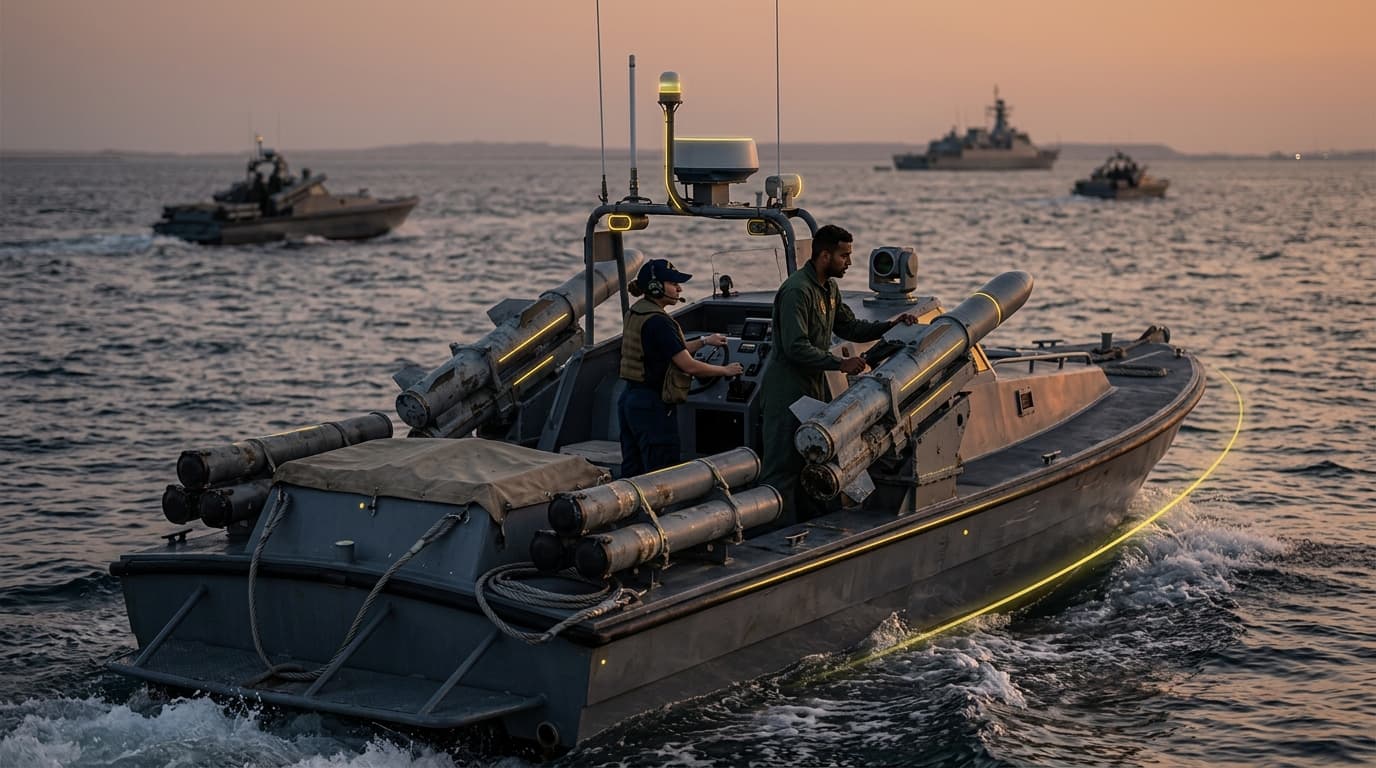
Fast Attack Craft and Asymmetric Naval Platforms
Geography: Emea · Middle East · Iran
Iran produces and operates a large fleet of fast attack craft (FAC) designed for asymmetric naval warfare in the confined waters of the Persian Gulf. The IRGC Navy operates hundreds of small, fast boats — including missile-armed variants — designed for swarming tactics against larger conventional warships. These platforms are equipped with anti-ship missiles, rocket launchers, mines, and in some cases torpedoes. Iran Shipbuilding and Offshore Industries Complex (ISIC) and IRGC-linked facilities produce these vessels domestically.
The concept of operations is deliberately asymmetric: rather than attempting to match US or allied naval forces in tonnage and firepower, Iran uses quantity, speed, and geography. In the narrow Persian Gulf, large warships have limited room to maneuver, while small, fast boats can emerge from coastal hiding positions, launch weapons, and withdraw. Combined with coastal missile batteries and mine warfare capability, the FAC fleet creates a threat environment that complicates naval operations disproportionately to its cost.
The technology is not individually sophisticated — most fast attack craft use commercial marine engines, basic navigation, and relatively simple weapons integration. The innovation lies in the doctrine and scale: Iran has optimized for cost-effective production of large numbers of simple platforms, creating a numerical threat that cannot be easily eliminated. This approach mirrors the drone warfare philosophy — overwhelming quality with quantity and shifting the cost-exchange ratio in Iran's favor.
Research this in Signals
Signals turns a topic into a sourced research record you can inspect and rerun. Your first scan is free, and this one starts with Fast Attack Craft and Asymmetric Naval Platforms already loaded, so edit it or scan as is.