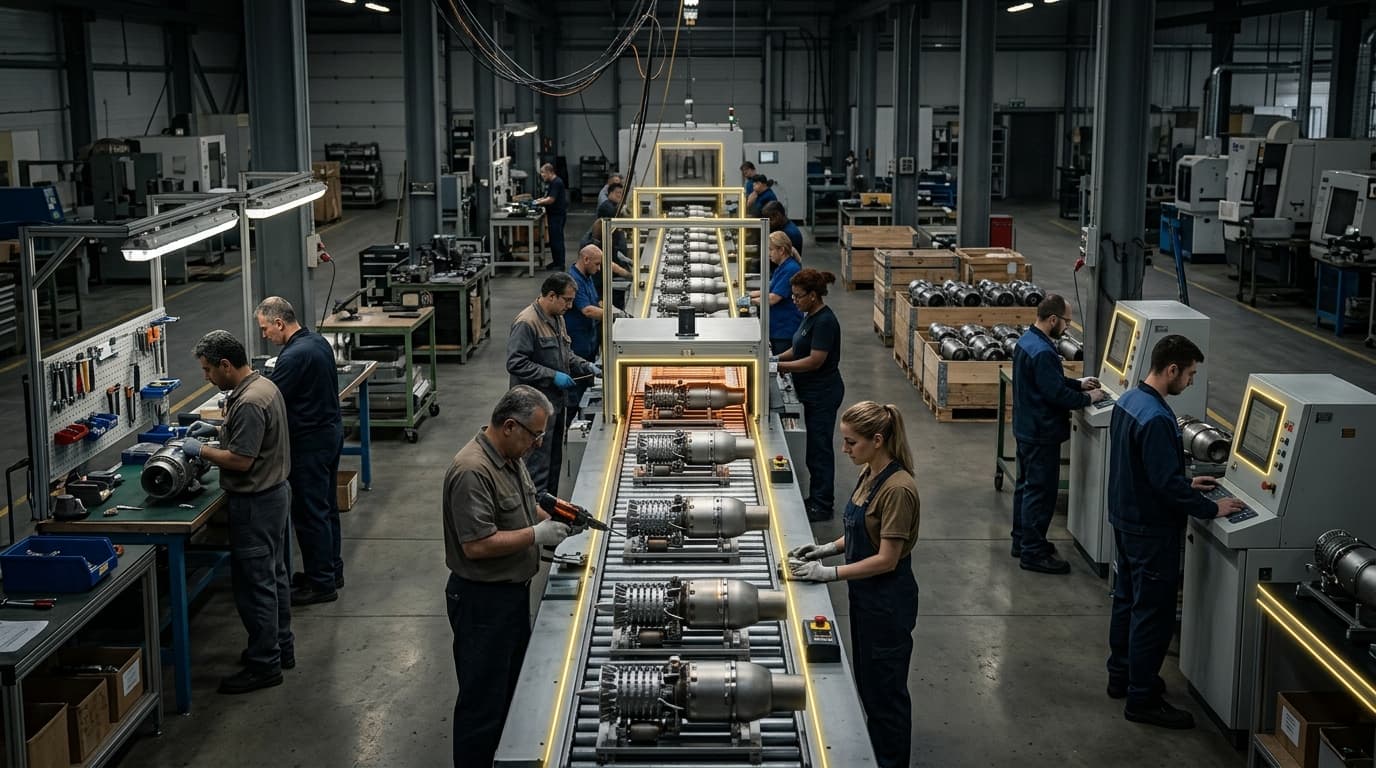
Low-Cost Turbojet Engine Mass Production
Geography: Emea · Middle East · Iran
Iran has established mass production capability for the small turbojet engines that power its Shahed-series loitering munitions. These engines — estimated at $2,000-5,000 per unit — are designed for simplicity, reliability over single-use flight profiles, and producibility at scale. The production volume is estimated in the thousands per year, sufficient to sustain the ongoing supply of drones to Russian forces and domestic requirements. Russia has begun manufacturing localized versions under technology transfer arrangements.
The mass production of cheap turbojet engines is a less visible but critical enabler of Iran's drone warfare model. Without affordable, producible engines, the low-cost loitering munition concept would not scale. Iranian engineers have optimized these engines for the specific operational requirement: sufficient thrust for a 2,000 km one-way flight carrying a warhead payload, with manufacturing tolerances loose enough for rapid production but tight enough for reliable operation. This is a different engineering challenge than building a high-performance turbofan — it is optimization for cost and volume rather than efficiency or longevity.
The technology transfer to Russia represents a significant moment in global defense industry dynamics: a Middle Eastern country providing manufacturing technology to a major military power. It also demonstrates the exportability of the underlying engine technology — if Iran can transfer production to Russia, the same could potentially occur with other countries, further proliferating the low-cost drone warfare model. The engine production capability is a bottleneck technology: many countries can build airframes and load waypoints, but serial production of reliable jet engines at scale requires industrial infrastructure that few possess.
Research this in Signals
Signals turns a topic into a sourced research record you can inspect and rerun. Your first scan is free, and this one starts with Low-Cost Turbojet Engine Mass Production already loaded, so edit it or scan as is.