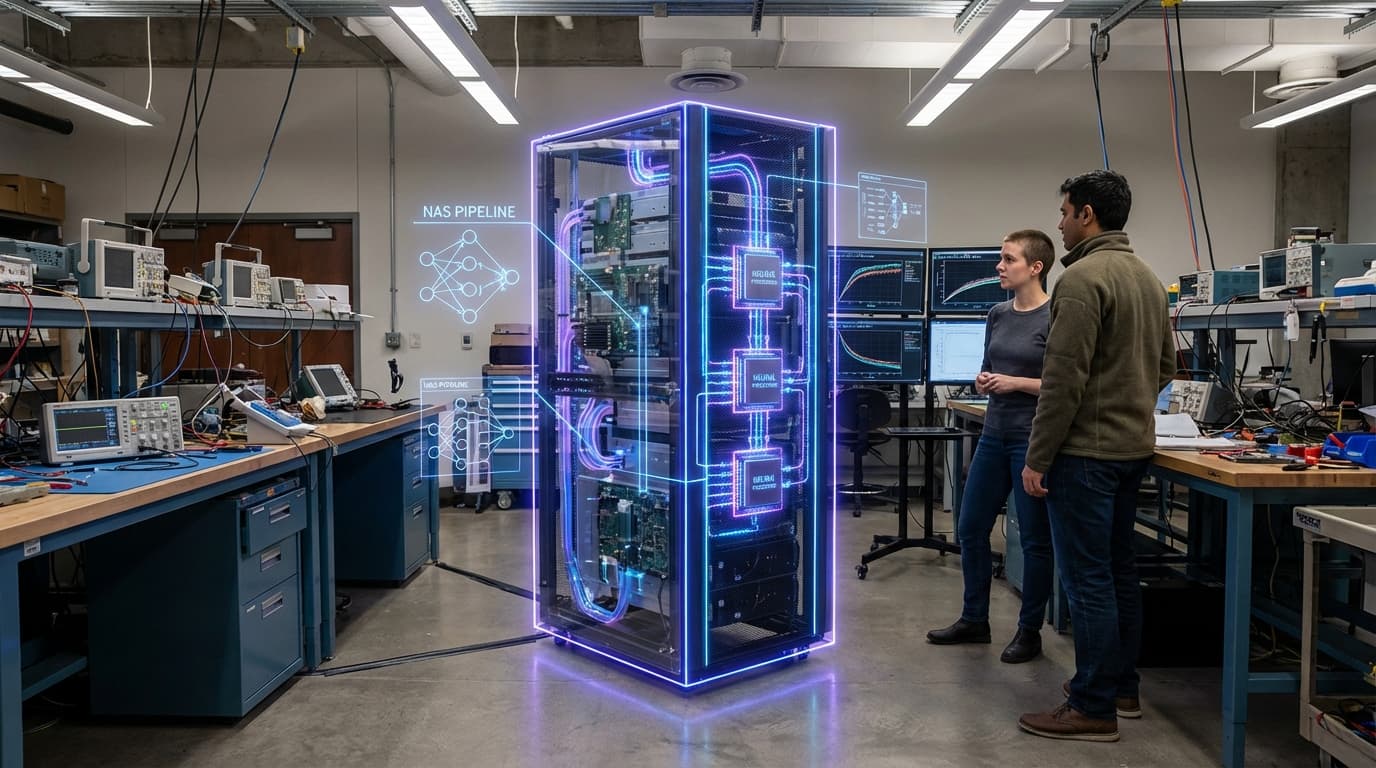
Neural Architecture Search Services
Neural architecture search (NAS) services use automated algorithms to explore vast spaces of possible neural network architectures, testing different combinations of layers, activation functions, connectivity patterns, and sparsity strategies to find optimal designs for specific tasks and constraints. These systems use multi-objective optimization to balance accuracy, latency, energy consumption, and model size, outputting architectures tailored to specific deployment scenarios.
This innovation addresses the time-intensive and expertise-dependent process of manually designing neural network architectures, which requires deep knowledge and extensive experimentation. By automating architecture exploration, NAS services can discover high-performing models more efficiently and identify architectures optimized for specific hardware platforms or deployment constraints. Companies and cloud providers offer NAS services, enabling developers to find optimal architectures for edge devices, enterprise servers, or safety-critical applications.
The technology is particularly valuable for edge AI applications where model size, latency, and energy consumption are critical constraints. As AI deployment expands to diverse hardware platforms and use cases, NAS services enable developers to find architectures that maximize performance within specific constraints. However, NAS can be computationally expensive, requiring significant resources to explore architecture spaces, though techniques like weight sharing and proxy tasks are making it more efficient.
Related Organizations

Offers Vertex AI NAS, a managed service for automating the design of neural network architectures.
United States · University
Academic lab led by Song Han, famous for ProxylessNAS, MCUNet, and efficient deep learning research.
Developing foundation models for robotics (Project GR00T) and vision-language models like VILA.
United States · Startup
Provides the LEIP SDK for optimizing neural networks for the edge, including architecture search components.

Through Copilot and the 'Recall' feature in Windows, Microsoft is integrating persistent memory and agentic capabilities directly into the operating system.
South Korea · Startup
Develops NetsPresso, a hardware-aware AI model optimization platform using NAS.

Enterprise AI platform offering automated machine learning including model selection and architecture optimization.

Provides Driverless AI, an AutoML platform that includes architecture search and hyperparameter tuning.
United States · Startup
Specializes in software-based acceleration using sparsity and pruning, often involving architecture modification.

Offers the AI Stack which includes tools for hardware-aware model efficiency and architecture search.
Supporting Evidence
Research this in Signals
Signals turns a topic into a sourced research record you can inspect and rerun. Your first scan is free, and this one starts with Neural Architecture Search Services already loaded, so edit it or scan as is.