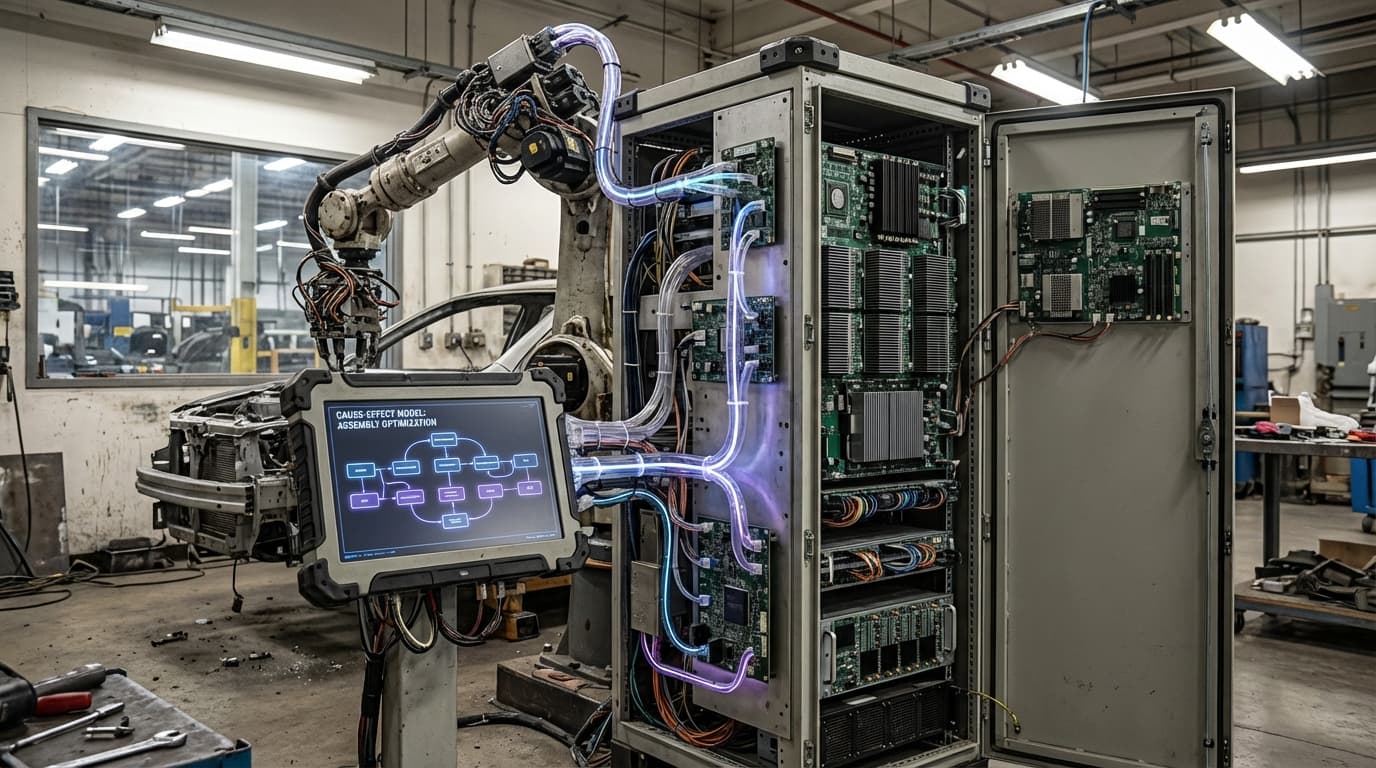
Causal Inference Engines
Causal inference engines use machine learning and statistical methods to identify cause-and-effect relationships from observational data, going beyond correlation to understand what interventions will actually produce desired outcomes. These systems combine structural causal models, counterfactual reasoning, and observational data analysis to answer "what if" questions and predict the effects of interventions, enabling evidence-based decision-making.
This innovation addresses a fundamental limitation of traditional machine learning, which excels at finding patterns and correlations but struggles with causal understanding. For many real-world decisions—from medical treatments to business policies to industrial processes—understanding causation is essential. Causal inference engines enable enterprises to make better decisions by predicting the actual effects of actions rather than just identifying associations. Companies and research institutions are developing these capabilities, with applications in healthcare, economics, marketing, and industrial optimization.
The technology is particularly valuable for decision-making in complex systems where controlled experiments are difficult or impossible, such as healthcare (where randomized trials are expensive or unethical), business policy (where experiments may be risky), and industrial processes (where experimentation may be costly). As AI is deployed for high-stakes decision-making, causal inference provides the reasoning capabilities needed to make reliable predictions about interventions. However, causal inference requires strong assumptions and domain knowledge, and results depend on the quality of the causal models and data.
Related Organizations

Develops a Causal AI platform for enterprise decision making.

Through Copilot and the 'Recall' feature in Windows, Microsoft is integrating persistent memory and agentic capabilities directly into the operating system.

Long-standing leader in neuro-symbolic AI, combining neural networks with logical reasoning for enterprise applications.

Consultancy and core developers of PyMC, a Bayesian modeling library used for causal inference.
United States · Company
Conducts extensive research on causal discovery and causal representation learning.

Open source project for Double Machine Learning, a method for causal inference.

Creators of CausalImpact, a package for causal inference using Bayesian structural time-series.

Uber
United States · Company
Developers of CausalML, an open-source Python package for uplift modeling.

Heavy users and researchers of causal inference for personalization and content delivery.
Supporting Evidence
Research this in Signals
Signals turns a topic into a sourced research record you can inspect and rerun. Your first scan is free, and this one starts with Causal Inference Engines already loaded, so edit it or scan as is.