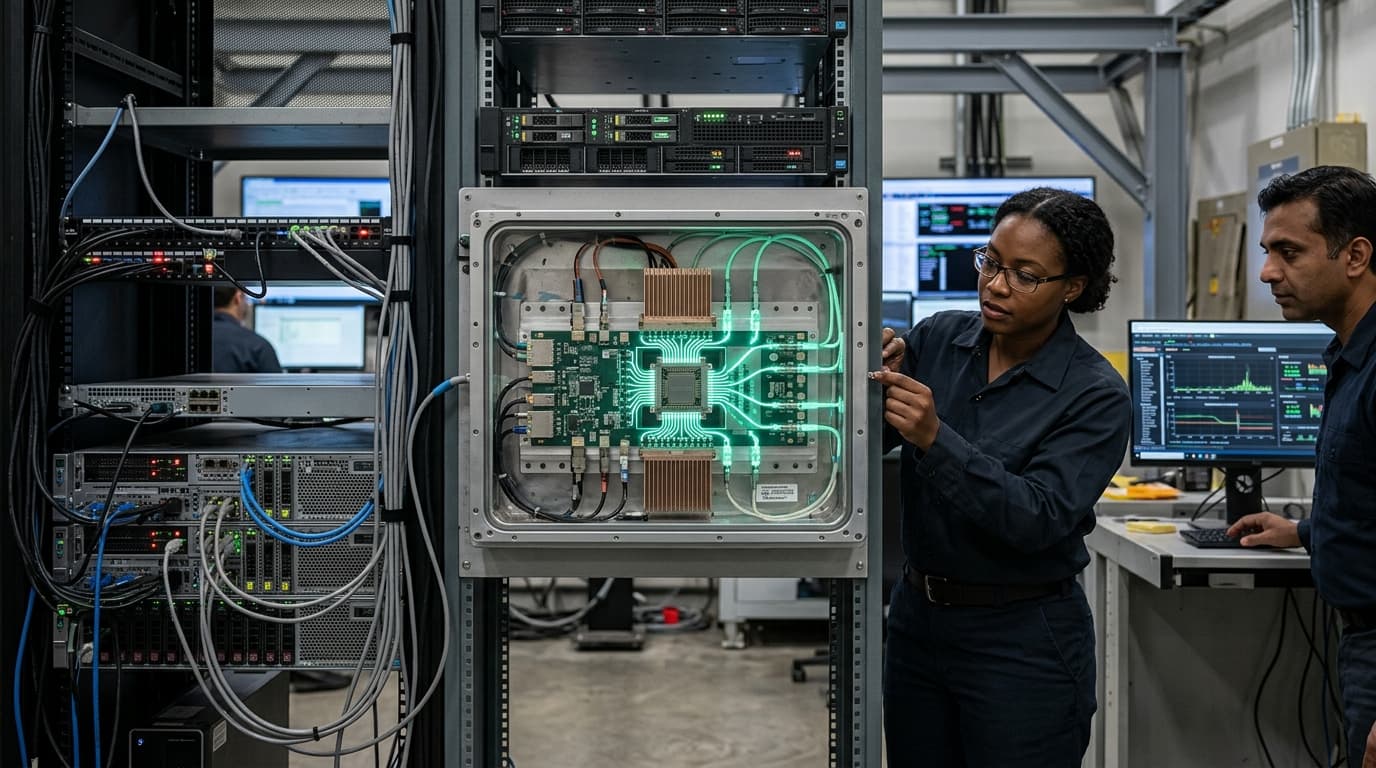
Miniaturised Quantum Systems
Miniaturised quantum systems pack quantum processors, sensors, or communication nodes into compact, often chip-scale or portable form factors. Approaches include integrated photonic or superconducting circuits, trapped-ion or neutral-atom systems with smaller vacuum and optical assemblies, and solid-state qubits (e.g. nitrogen-vacancy centres, quantum dots) integrated with classical control and readout. Miniaturisation can reduce cost, power, and footprint and enable deployment in vehicles, field sites, or networked nodes. Applications range from portable quantum sensors (magnetometry, gravimetry) to nodes in future quantum networks or distributed quantum computing.
The technology addresses the bulk and cost of first-generation quantum systems, which often require large cryostats, racks of control electronics, and specialised facilities. Smaller systems could broaden access to quantum sensing and communication and support integration with classical infrastructure. Research is advancing on integration of qubits, control, and cooling; some miniaturised sensors are already commercial or in field trials.
Challenges include maintaining performance (coherence, connectivity) at smaller scale and managing thermal and electromagnetic environment. Not all qubit types are equally amenable to miniaturisation. As integration and packaging improve, miniaturised quantum systems are likely to expand from sensing and niche computing roles toward broader deployment in networks and edge applications.
Research this in Signals
Signals turns a topic into a sourced research record you can inspect and rerun. Your first scan is free, and this one starts with Miniaturised Quantum Systems already loaded, so edit it or scan as is.