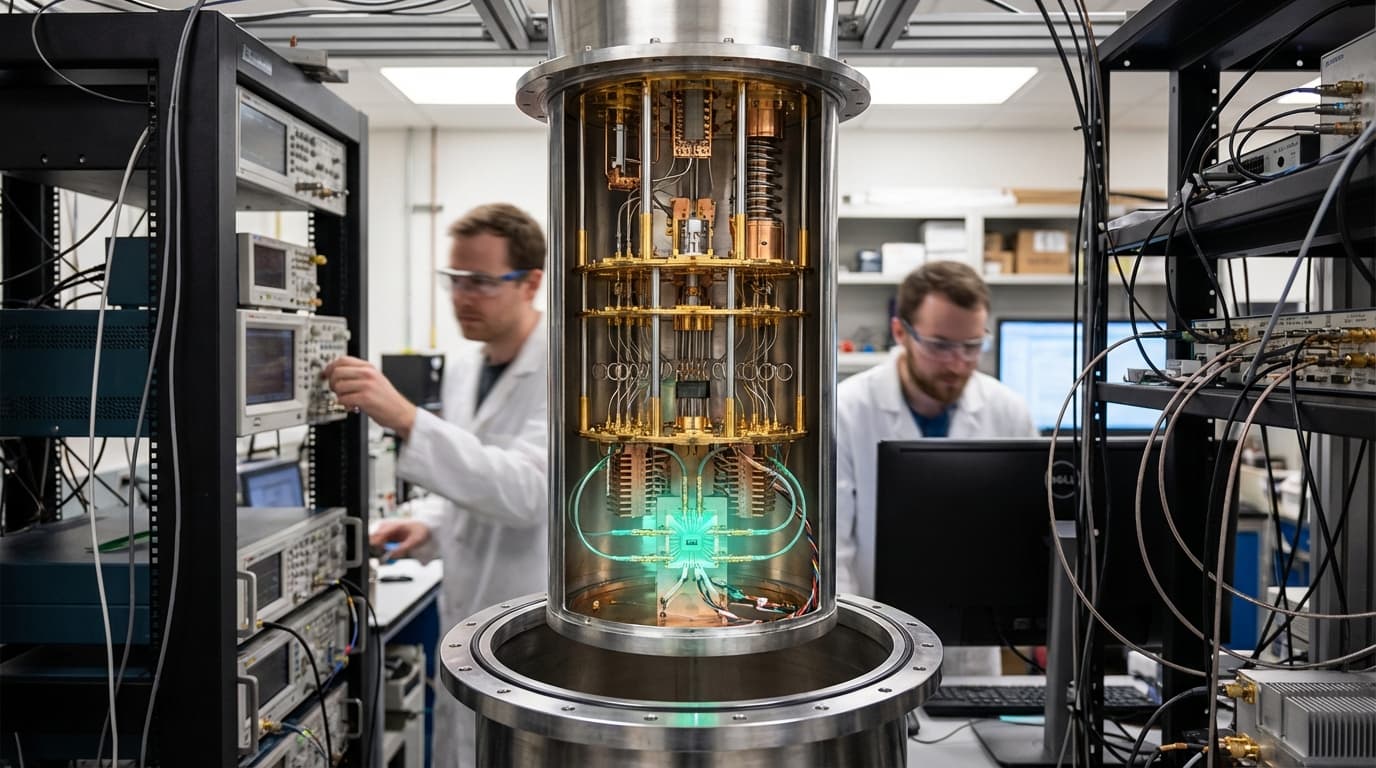
Josephson Parametric Amplifiers
Josephson parametric amplifiers (JPAs) are ultra-low-noise microwave amplifiers that use nonlinear superconducting elements (Josephson junctions, which are superconducting devices with nonlinear properties) to provide quantum-limited gain (amplification that approaches the fundamental quantum limit, adding minimal noise) for microwave signals emerging from superconducting qubits (quantum bits made from superconducting circuits). Their wide deployment on readout lines (circuits that measure qubit states) improves fidelity (accuracy of measurements), allows multiplexing of qubit measurements (measuring multiple qubits simultaneously), and is foundational for scaling superconducting quantum chips past 1,000 qubits, where efficient readout becomes critical for managing the large number of qubits, making JPAs essential infrastructure for large-scale superconducting quantum computers.
This innovation addresses the challenge of reading out quantum states, where signals are extremely weak and noisy. By providing quantum-limited amplification, JPAs enable reliable readout. Companies and research institutions are developing and deploying these amplifiers.
The technology is essential for scaling superconducting quantum computers, where efficient readout is necessary for large systems. As quantum computers scale, JPAs become increasingly important. However, ensuring performance, managing complexity, and achieving consistent operation remain challenges. The technology represents mature infrastructure for superconducting quantum computing, but requires continued development to support larger systems. Success is already being achieved, with JPAs widely deployed in superconducting quantum computers. JPAs are a mature technology that is essential for current superconducting quantum computing systems.
Related Organizations
Netherlands · Startup
Develops and sells off-the-shelf superconducting quantum hardware components, including the 'Crescendo' Traveling Wave Parametric Amplifier (TWPA).
United States · Research Lab
Operates a dedicated superconducting electronics foundry and researches cryogenic computing architectures.

The US federal agency leading the global competition to select and standardize post-quantum cryptographic algorithms.

Finnish university with strong research groups in superconducting circuits and microwave quantum optics relevant to radar.

Home to the Wallenberg Centre for Quantum Technology, where researchers actively develop wideband TWPAs and Josephson junction circuits.
United States · Company
Participant in IARPA's C3 (Cryogenic Computing Complexity) program.

Japan's largest comprehensive research institution, with significant work in brain science and bio-hybrid systems.
Fermi National Accelerator Laboratory
United States · Government Agency
Developed the Quantum Instrumentation Control Kit (QICK), an open-source FPGA-based controller and software stack.
United States · Startup
Develops digital superconducting chips for quantum control and classical co-processing.
Supporting Evidence
Research this in Signals
Signals turns a topic into a sourced research record you can inspect and rerun. Your first scan is free, and this one starts with Josephson Parametric Amplifiers already loaded, so edit it or scan as is.