Controlled Environment Agriculture
Geography: Emea · Europe · Europe
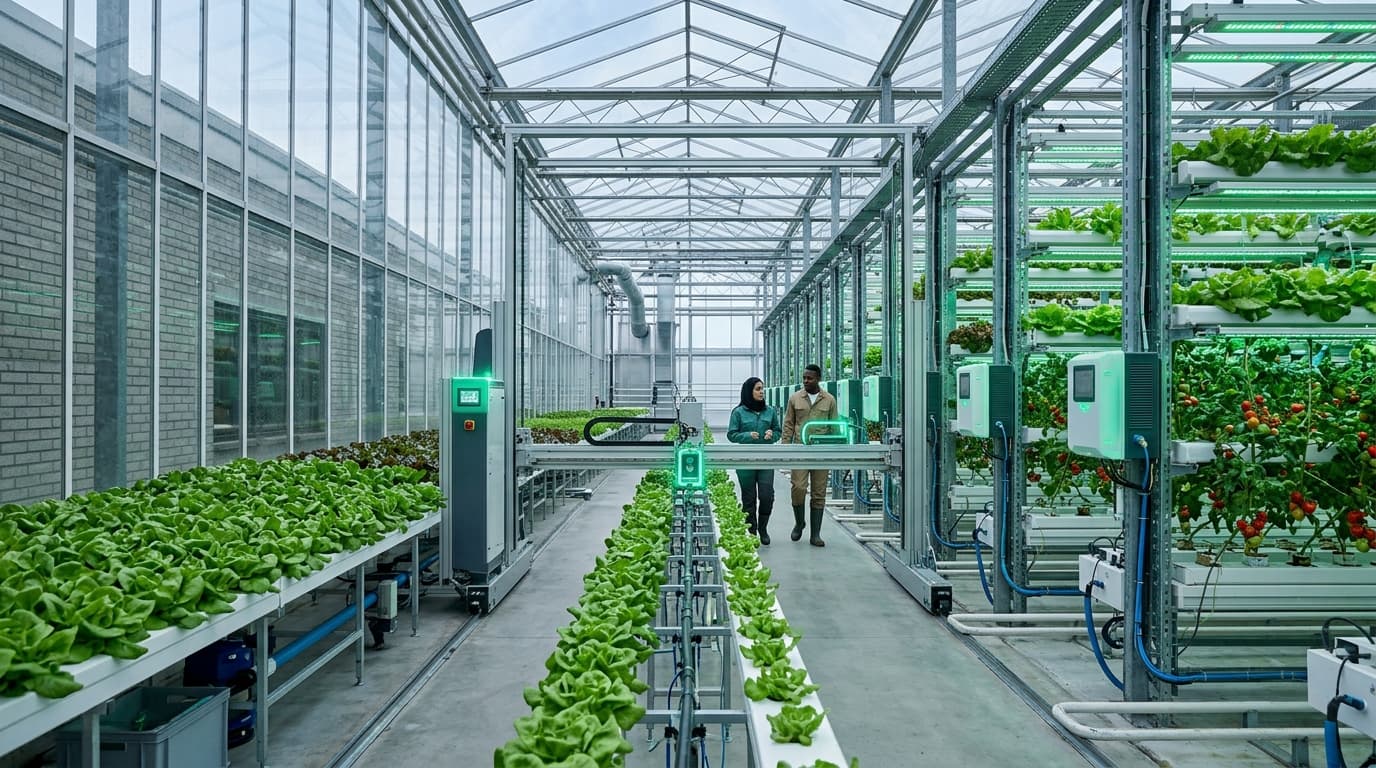
The Netherlands operates the world's most advanced controlled environment agriculture (CEA) ecosystem, using sensor-driven greenhouses that precisely regulate temperature, humidity, CO2, light spectrum, and nutrient delivery to achieve yields 10x higher per hectare than open-field farming. Dutch greenhouses use 90% less water than conventional agriculture while producing premium produce year-round. Wageningen University's GREENCONTROL project (2025) is pushing further: shifting from 'climate control' to 'plant control' — where the environment dynamically adapts to individual plant needs in real-time.
The Westland greenhouse cluster near The Hague concentrates 80+ km² of glass greenhouses into a single agro-industrial complex, making the Netherlands the world's second-largest agricultural exporter (after the US) despite being 237 times smaller. The technology stack includes LED grow lights tuned to photosynthetically active wavelengths, AI-driven climate computers, robotic harvesting systems, and closed-loop water recycling. Dutch greenhouse companies export complete turnkey systems to the Middle East, Africa, and Asia.
The strategic significance extends beyond food production: Dutch CEA technology represents a climate adaptation pathway. As temperatures rise, water becomes scarce, and arable land degrades globally, controlled environment systems that can produce food anywhere — deserts, cities, arctic regions — become critical infrastructure. The Dutch Greenhouse Delta foundation actively promotes technology transfer, positioning the Netherlands as the global supplier of food production technology in a climate-stressed world.
Research this in Signals
Signals turns a topic into a sourced research record you can inspect and rerun. Your first scan is free, and this one starts with Controlled Environment Agriculture already loaded, so edit it or scan as is.