









Offshore Floating Wind Turbines
Floating Offshore Wind Platforms
Wind turbines on buoyant structures for deep-water ocean energy generation
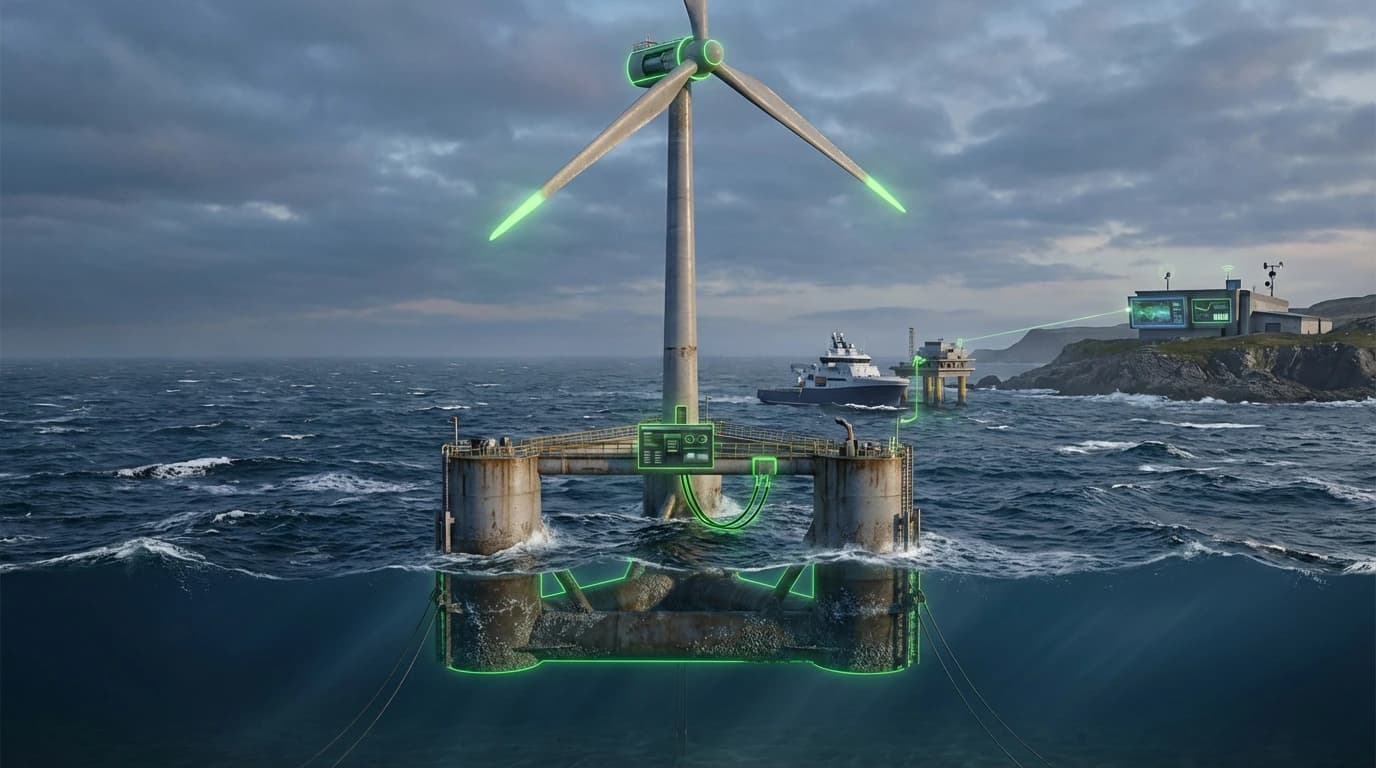
Floating offshore wind platforms represent a breakthrough in renewable energy infrastructure, enabling wind turbines to operate in ocean waters far deeper than traditional fixed-bottom installations can reach. Unlike conventional offshore wind farms that require foundations anchored directly to the seabed—typically limited to depths of 50-60 meters—floating platforms use buoyant structures tethered to the ocean floor with mooring lines and anchors. These platforms employ several design approaches, including spar-buoy configurations that use ballasted cylinders extending deep below the surface, semi-submersible designs with multiple columns providing stability, and tension-leg platforms that rely on taut mooring lines. The turbines themselves are mounted atop these floating foundations, which maintain stability through a combination of buoyancy, ballast, and mooring tension, allowing them to withstand the dynamic forces of waves, currents, and wind while keeping the turbine operational.
The technology addresses a fundamental limitation in offshore wind development: the vast majority of the world's best wind resources exist in waters too deep for conventional fixed foundations. Coastal regions with steep continental shelves—such as the U.S. West Coast, Japan, the Mediterranean, and parts of Northern Europe—possess exceptional wind conditions but lack the shallow seabeds necessary for traditional offshore wind farms. Floating platforms unlock these previously inaccessible areas, potentially expanding the global offshore wind resource by orders of magnitude. Beyond geographical reach, floating installations can be positioned farther from shore where wind speeds are typically higher and more consistent, resulting in improved capacity factors compared to nearshore alternatives. The ability to assemble platforms in port and tow them to deployment sites also reduces installation complexity and potentially lowers costs compared to the specialized vessels required for fixed-bottom construction in challenging marine environments.
Early commercial deployments have already demonstrated the viability of floating wind technology, with projects operational off the coasts of Scotland, Portugal, and Norway providing valuable operational data and driving design refinements. Industry analysts note that while current installations remain relatively small-scale, several countries have announced ambitious targets for floating offshore wind capacity over the coming decades, with particular momentum in Asia and along the U.S. Pacific coast. The technology benefits from ongoing advances in materials science, mooring systems, and dynamic cable designs that can withstand the constant motion of floating platforms. As the global energy transition accelerates and nations seek to decarbonize their electricity grids, floating offshore wind platforms are positioned to play an increasingly vital role in accessing the enormous untapped wind resources of the world's deeper waters, complementing both onshore wind and fixed-bottom offshore installations in the broader renewable energy portfolio.
TRL
7/9Operational
Impact
3/5
Investment
3/5
Category
Hardware
Related Organizations
Energy major actively testing and deploying automated drilling technologies on the Norwegian Continental Shelf.
Developer
Designers of the WindFloat semi-submersible floating wind foundation technology.
Developer
A major wind turbine manufacturer that has deployed the world's first typhoon-resistant floating wind turbine.
Developer
Developing a hybrid floating wind platform that combines tension-leg and semi-submersible features.
Developer
Develops TwinWind, a floating platform that hosts two turbines on a single foundation.
Developer
Maintains the efficiency charts for solar cells and conducts foundational research on perovskite stability.
Researcher
A leading early-stage developer of floating offshore wind projects in the Blue Economy.
Developer
Expert partner for businesses to decarbonize, providing certification for product carbon footprints.
Standards Body
Developing a downwind, pivot-buoy floating wind system that self-aligns with the wind.
Developer
What was expected
Published forecasts about this technology, graded against what happened in Hindsight.
Supporting Evidence
Evidence data is not available for this technology yet.
Research this in Signals
Scan Floating Offshore Wind Platforms for yourself.
Signals turns a topic into a sourced research record you can inspect and rerun. Your first scan is free, and this one starts with Floating Offshore Wind Platforms already loaded, so edit it or scan as is.