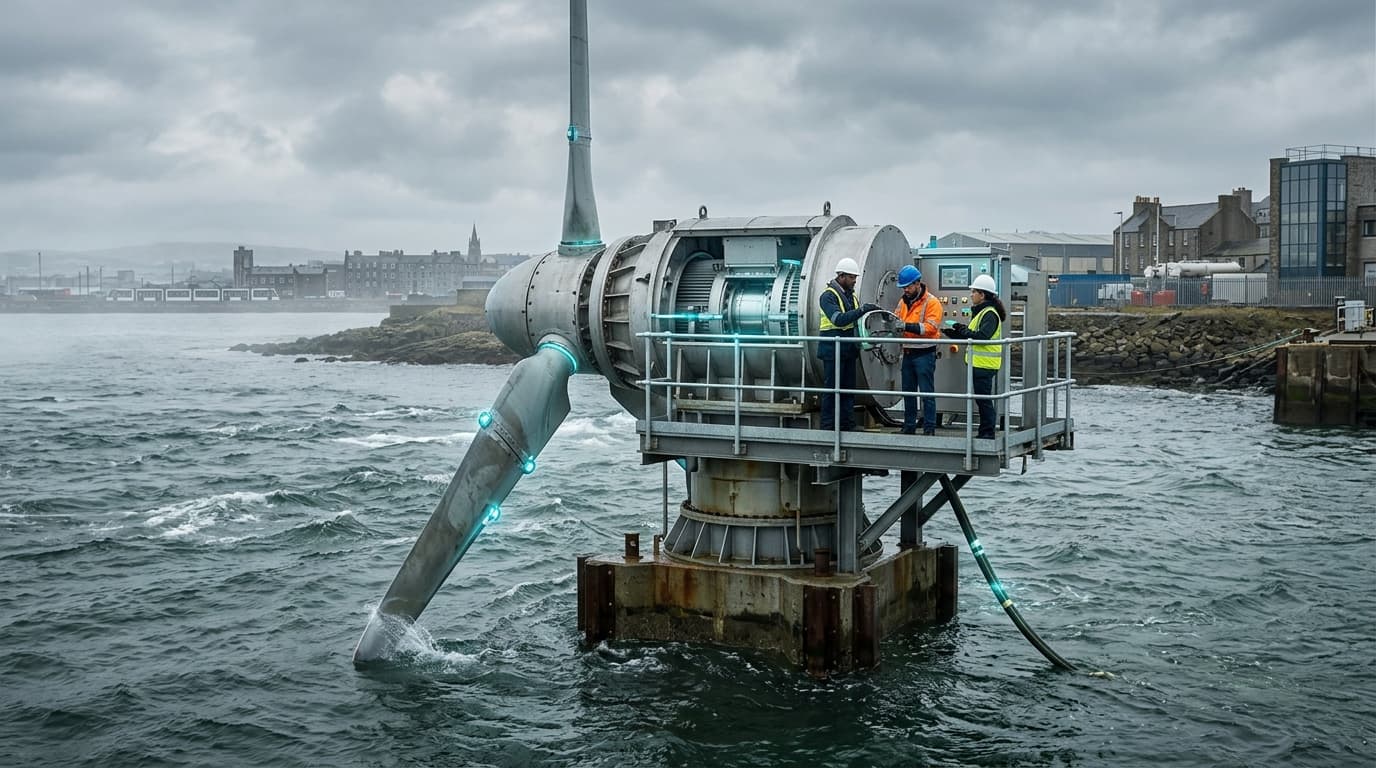
Tidal Stream Turbines
Geography: Emea · Europe · Europe
MeyGen, the world's largest tidal stream energy project in Scotland's Pentland Firth, has generated over 84 GWh of electricity from underwater turbines anchored to the seabed. One turbine achieved 6.5 years of continuous operation without unplanned or disruptive maintenance — a reliability benchmark that no other marine energy technology has matched. The project is expanding from 6 MW to become a large-scale commercial array.
Tidal energy's unique advantage is perfect predictability: unlike wind or solar, tidal flows can be calculated centuries in advance from astronomical data. The UK alone has 11 GW of tidal stream potential, concentrated in sites where geography accelerates tidal currents through narrow channels — the Pentland Firth, Alderney Race (Channel Islands), and the Strait of Messina (Italy). Europe's complex coastline with fjords, islands, and straits creates natural acceleration zones ideal for turbine deployment.
Orbital Marine Power (Scotland) complements the seabed-mounted approach with floating tidal turbines, and Nova Innovation demonstrated the world's first offshore tidal array in Shetland. The European Marine Energy Centre (EMEC) in Orkney serves as the global testing hub for tidal devices. EMEC completed a 3-in-1 demonstration combining tidal energy, hydrogen production, and battery storage in 2025 — pointing toward integrated marine energy systems rather than single-technology deployments.
Research this in Signals
Signals turns a topic into a sourced research record you can inspect and rerun. Your first scan is free, and this one starts with Tidal Stream Turbines already loaded, so edit it or scan as is.