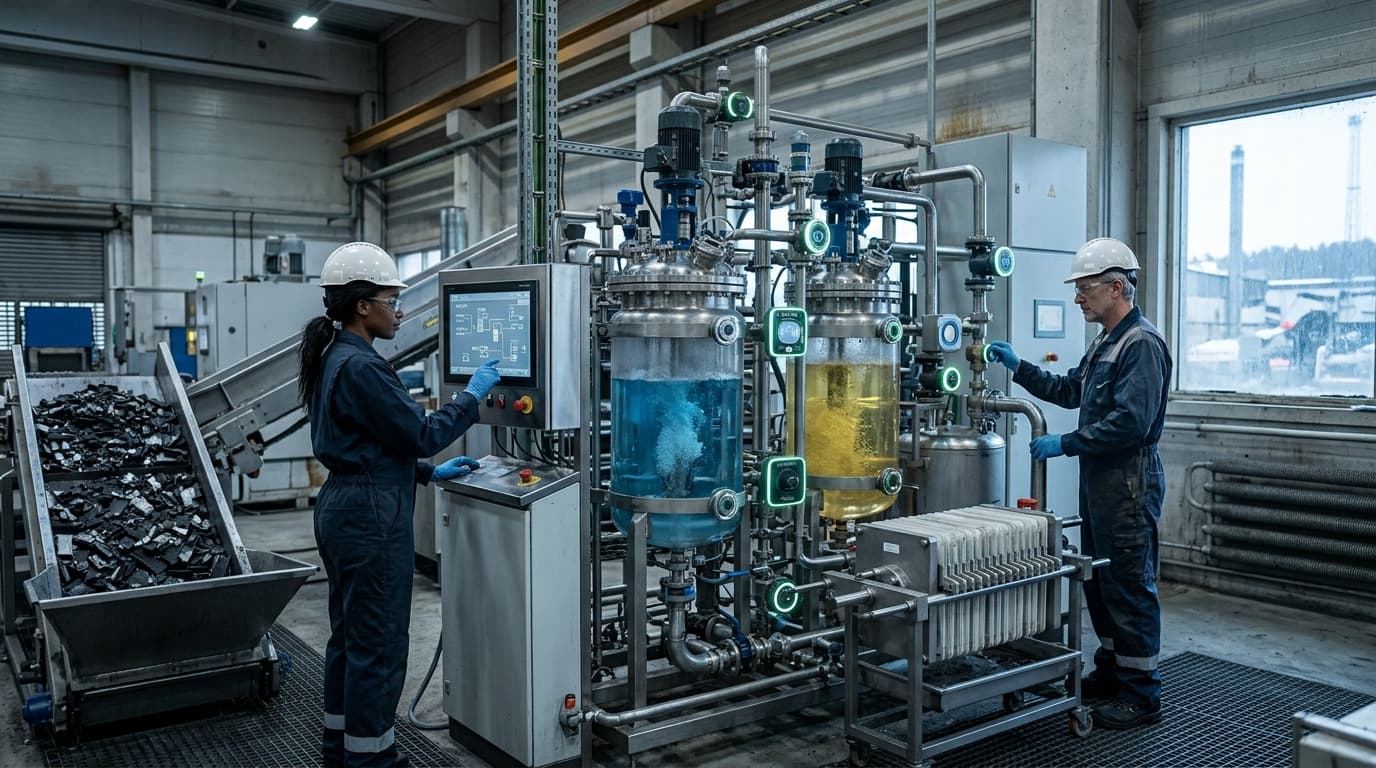
Battery Recycling Hydrometallurgy
Geography: Emea · Europe · Europe
Hydrovolt (Norway, Northvolt/Hydro joint venture) operates Europe's largest EV battery recycling facility in Fredrikstad, recovering 95% of materials from spent lithium-ion batteries using a combination of mechanical shredding and hydrometallurgical processing. The plant produces 'black mass' — a concentrate of cobalt, nickel, lithium, and manganese — that is then refined back into battery-grade materials at Northvolt's facility in Sweden, creating a closed-loop battery supply chain.
The EU Battery Regulation (effective 2027) creates a regulatory mandate for recycled content that transforms battery recycling from a waste management cost into a strategic supply chain necessity. New batteries sold in Europe must contain minimum percentages of recycled cobalt (16%), lithium (6%), nickel (6%), and lead (85%). These mandates will tighten over time, making hydrometallurgical recycling — which recovers materials at higher purity than pyrometallurgy (smelting) — the preferred technology pathway.
The Nordic recycling ecosystem extends beyond Hydrovolt: Finland's Fortum has developed a hydrometallurgical process recovering 95%+ of critical metals, while German companies like Duesenfeld use a vacuum-thermal approach. The scale challenge is timing: the first major wave of EV batteries reaching end-of-life is expected in the late 2020s, and Europe needs recycling capacity of 300,000+ tonnes per year by 2030 to meet its own circular economy targets. Building this infrastructure now creates a strategic advantage — reducing Europe's dependence on mined lithium from Australia and cobalt from the DRC.
Research this in Signals
Signals turns a topic into a sourced research record you can inspect and rerun. Your first scan is free, and this one starts with Battery Recycling Hydrometallurgy already loaded, so edit it or scan as is.