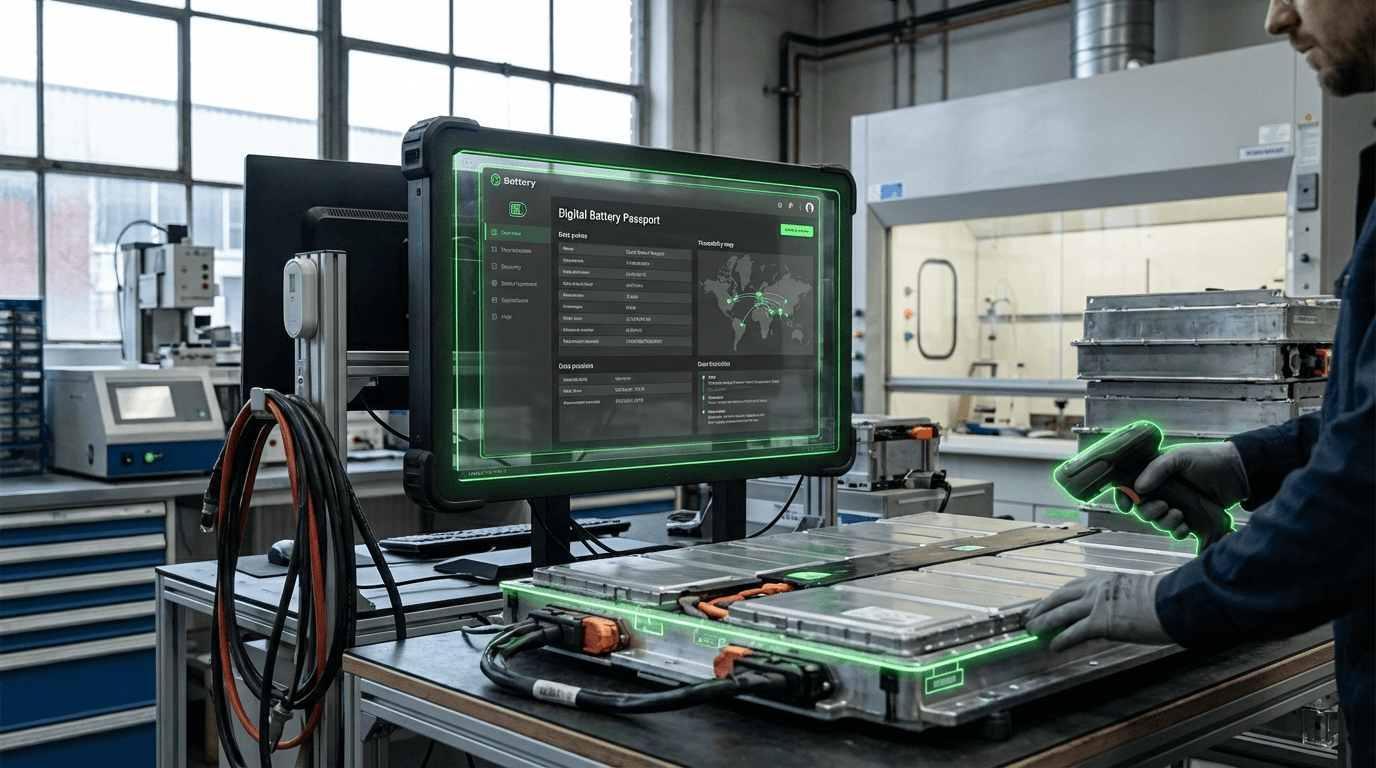
Digital Battery Passports
The rapid expansion of battery deployment across electric vehicles and grid-scale energy storage has created an urgent need for comprehensive lifecycle tracking systems. Digital Battery Passports represent a standardised digital framework that records and maintains detailed information about each battery unit throughout its entire lifecycle, from raw material extraction through manufacturing, operational use, and eventual recycling or disposal. These systems leverage technologies such as blockchain, QR codes, RFID tags, and cloud-based databases to create immutable records of a battery's chemical composition, manufacturing origin, performance metrics, charging cycles, degradation patterns, and maintenance history. By establishing a unique digital identity for each battery, these passports enable stakeholders across the supply chain to access critical information about material provenance, ethical sourcing compliance, and technical specifications that determine optimal use cases and end-of-life pathways.
The implementation of Digital Battery Passports addresses several critical challenges facing the energy storage industry and regulatory landscape. As governments worldwide introduce stricter circular economy regulations and extended producer responsibility requirements, manufacturers need reliable systems to demonstrate compliance with material sourcing standards, carbon footprint targets, and recycling obligations. These passports solve the persistent problem of information asymmetry in secondary markets, where buyers of used batteries previously had limited visibility into degradation levels and remaining useful life. This transparency enables more accurate valuation of retired electric vehicle batteries for second-life applications in stationary storage, where batteries that no longer meet automotive performance standards can still provide years of service in less demanding grid applications. Furthermore, the detailed material composition data embedded in these passports streamlines recycling processes by allowing facilities to optimise recovery techniques for specific battery chemistries, improving the economic viability of recycling operations and reducing reliance on virgin material extraction.
Early regulatory frameworks, particularly the European Union's Battery Regulation which mandates digital passports for industrial and EV batteries, are driving initial adoption across the industry. Major automotive manufacturers and battery producers are developing pilot implementations that integrate passport data into their manufacturing execution systems and customer-facing platforms. These deployments indicate that digital passports will become standard infrastructure within the battery ecosystem, supporting emerging business models such as battery-as-a-service offerings and automated warranty claims processing. As the global battery market continues its exponential growth trajectory, driven by electrification targets and renewable energy integration, Digital Battery Passports represent essential infrastructure for building a truly circular battery economy. The technology aligns with broader industry movements toward supply chain transparency, sustainable manufacturing practices, and the development of sophisticated battery management systems that can leverage historical performance data to optimise charging strategies and predict maintenance needs across distributed energy storage networks.
Related Organizations

Public-private partnership establishing the Battery Passport.

A German government-funded consortium developing content and technical standards for the EU Battery Passport.

Provides supply chain traceability and battery passports to ensure ethical sourcing and recycling verification.

A blockchain protocol for tracking responsible mineral sourcing in the supply chain.

An open data ecosystem for the automotive industry to create a uniform standard for information and data sharing.

Uses blockchain to create digital records of provenance for high-value assets like diamonds, art, and minerals.
RCS Global
Germany · Company
A leader in responsible sourcing auditing and digital supply chain mapping (Vine).

Europe's largest application-oriented research organization.

A battery manufacturer with a dedicated recycling program (Revolt) aiming for 50% recycled material in new cells by 2030.

Enterprise software giant providing data analytics solutions to esports teams like Team Liquid.

Industrial giant offering the 'Senseye Predictive Maintenance' suite and MindSphere IoT platform.
Supporting Evidence
Research this in Signals
Signals turns a topic into a sourced research record you can inspect and rerun. Your first scan is free, and this one starts with Digital Battery Passports already loaded, so edit it or scan as is.