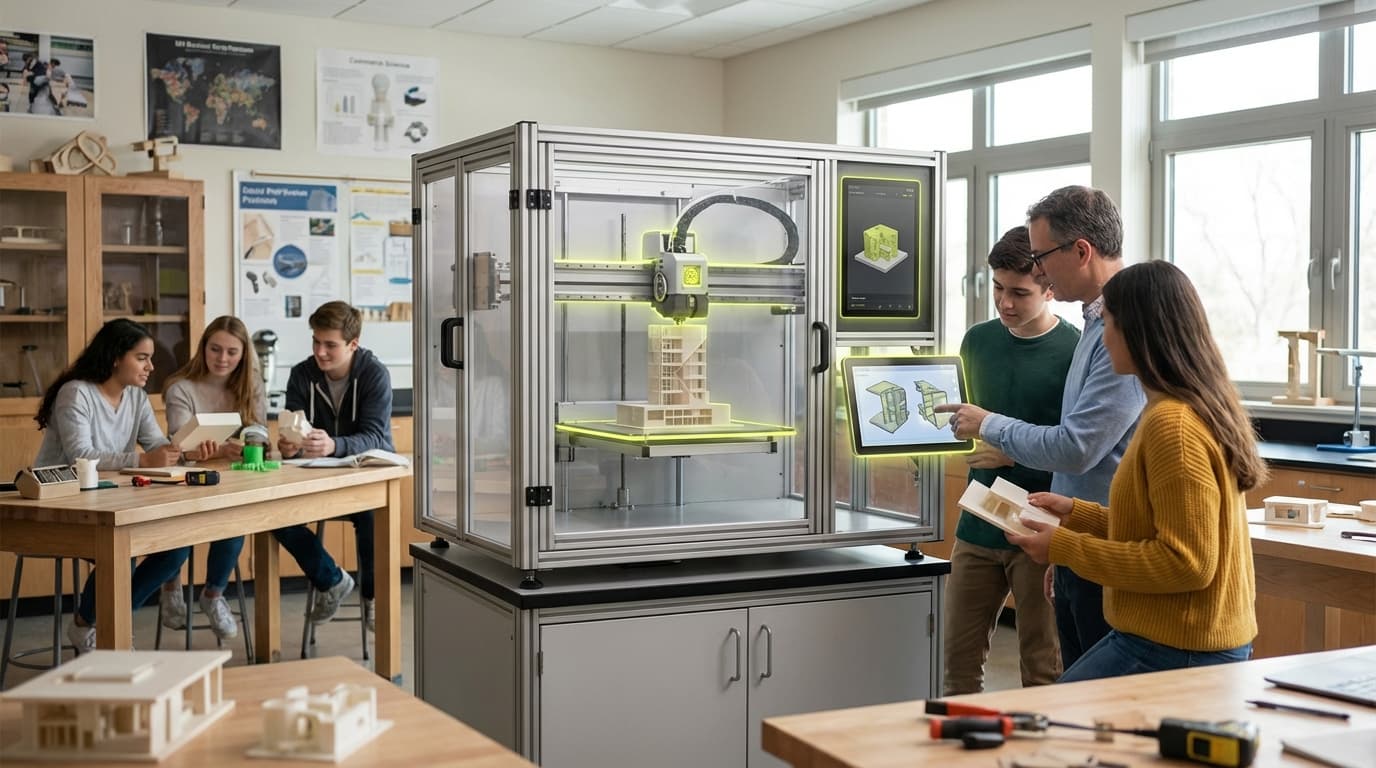
3D Printers for Education
Education-focused 3D printers are enclosed, low-emission desktop fabrication systems designed specifically for classroom use, featuring simplified software interfaces, safety features like enclosed build chambers and HEPA filtration, and educational content libraries that make 3D printing accessible to students of all ages. These printers use fused deposition modeling (FDM) or similar technologies to create physical objects from digital designs, enabling students to prototype engineering projects, create anatomical models for biology classes, build historical artifacts for social studies, or produce art installations. Educational models often include curriculum-aligned design libraries, step-by-step tutorials, and cloud-based design platforms that allow students to create and share designs easily.
This innovation addresses the gap between digital design skills and physical fabrication, where students can design in software but rarely have access to tools that bring their designs to life. By providing accessible 3D printing in educational settings, these systems enable hands-on learning, rapid prototyping, and the development of design thinking and engineering skills. Companies like MakerBot, Ultimaker, and various educational technology providers have developed classroom-focused 3D printers, with these devices becoming increasingly common in STEM programs, maker spaces, and design classes.
The technology is particularly significant for STEM education, where hands-on prototyping and design-build-test cycles are essential for developing engineering and design thinking skills. As 3D printing technology improves and costs decrease, these devices could become standard equipment in many educational settings. However, ensuring proper training, managing material costs, maintaining equipment, and integrating 3D printing meaningfully into curriculum remain challenges. The technology represents an important tool for hands-on, project-based learning, but requires thoughtful integration to maximize educational value.
Related Organizations

Owner of the Arnold renderer, which integrates AI denoising to optimize high-end VFX workflows for film and TV.

Manufacturer of the MakerBot Sketch and Method series, widely considered the standard for managed classroom 3D printing ecosystems.

Provider of 3D printing curriculum, teacher certification, and lesson plans focused on assistive technology and circular economy.

Open-source hardware manufacturer known for the i3 MK series and Prusa MINI, highly popular in university makerspaces and STEM labs.

Manufacturer of budget-friendly, fully enclosed 3D printers like the Adventurer and Finder series specifically targeted at K-12 schools.

Bambu Lab
China · Startup
Disruptor in the consumer space with high-speed, AI-assisted enclosed printers (X1C, P1S) rapidly being adopted by schools.

Leading 3D printing manufacturer focusing on SLA and SLS technology.

Major distributor and educator that curates 3D printing bundles, materials, and support specifically for schools and libraries.
Creators of the 3Doodler 3D printing pen, designed for early childhood and elementary education.

Manufacturer of industrial-grade FFF printers often used in vocational training and higher education research labs.
Supporting Evidence
Research this in Signals
Signals turns a topic into a sourced research record you can inspect and rerun. Your first scan is free, and this one starts with 3D Printers for Education already loaded, so edit it or scan as is.