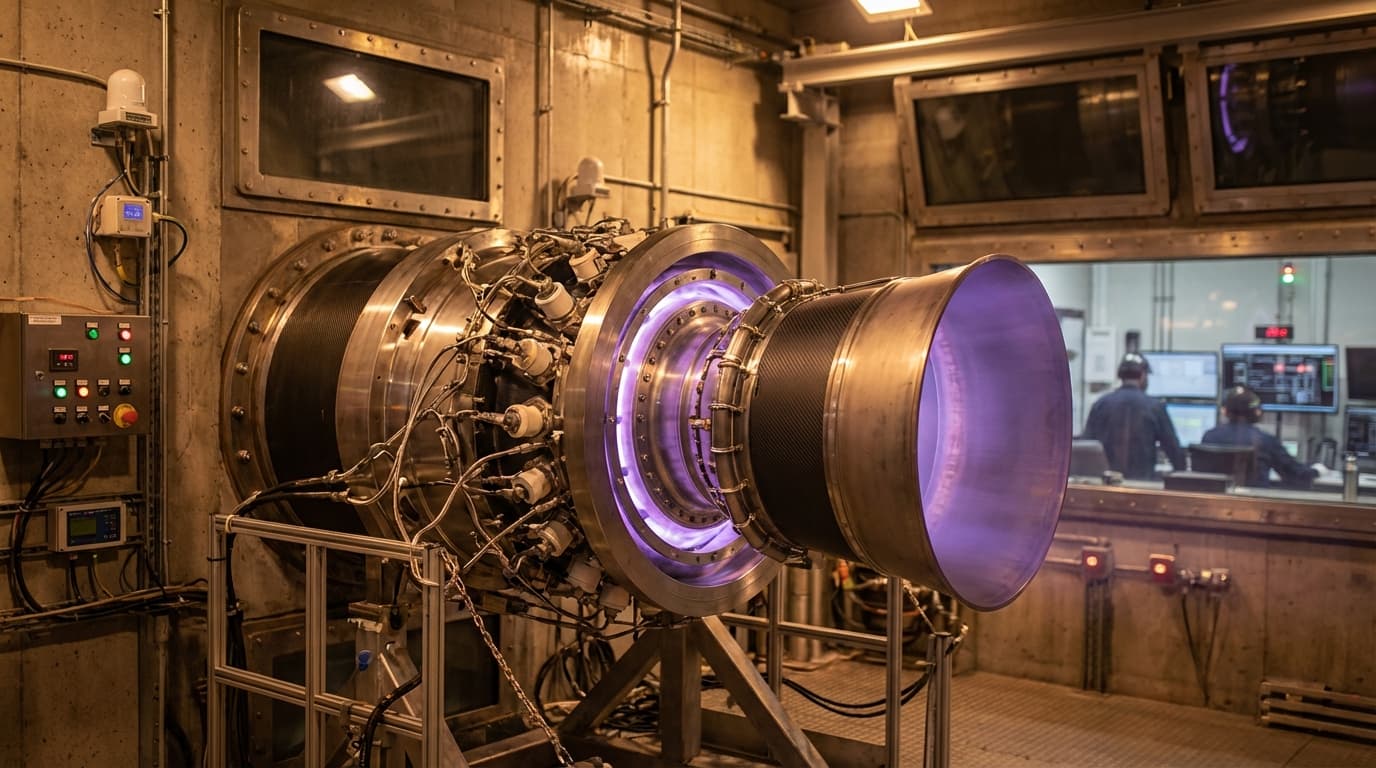
Rotating Detonation Rocket Engines (RDRE)
Rotating detonation rocket engines (RDRE) use continuous detonation waves that travel around an annular combustion chamber, creating pressure-gain combustion that is more efficient than traditional deflagration (slow-burning) engines. By harnessing the rapid energy release of detonation, RDREs can achieve significantly higher specific impulse (fuel efficiency) and thrust-to-weight ratios compared to conventional rocket engines, potentially revolutionizing upper-stage performance and lander propulsion systems.
This innovation addresses the fundamental efficiency limitations of traditional rocket engines, where most of the energy in propellant is wasted. By using detonation instead of deflagration, RDREs can extract more energy from the same amount of propellant, enabling missions that require more delta-v or allowing for smaller, lighter propulsion systems. NASA, DARPA, and various research institutions are developing these engines, with some successful test firings demonstrating the concept's feasibility.
The technology could significantly improve the efficiency of space transportation, enabling missions that are currently marginal or impossible with conventional propulsion. As RDRE technology matures, it could enable more efficient upper stages, better lander propulsion, and new mission concepts that require high efficiency. However, the technology faces significant challenges including controlling the detonation waves, managing heat loads, and ensuring reliability. The technology represents a potentially revolutionary advance in propulsion, but significant development work remains before it becomes operational. If successful, RDREs could transform space transportation efficiency, similar to how jet engines transformed aviation.
Related Organizations

Conducts advanced demonstrations like LCRD (Laser Communications Relay Demonstration) and DSOC (Deep Space Optical Comm).

Leading long-term research into SBSP, with plans to demonstrate power transmission from orbit by 2025.

Home to the Manfra Group, which grows the ultra-pure semiconductor nanowires needed for topological qubits.



Scientific research organization of the US Air Force.

World-leading provider of jet and turboprop engines.


The authorization and regulatory body promoting and overseeing private sector participation in India's space program.

Major US research university.
Supporting Evidence
Research this in Signals
Signals turns a topic into a sourced research record you can inspect and rerun. Your first scan is free, and this one starts with Rotating Detonation Rocket Engines (RDRE) already loaded, so edit it or scan as is.